How to Use ChatGPT and AI for Your Business Marketing (Without Losing Your Voice)
AI writing tools have created a new category of marketing content: technically competent but distinctly generic. Posts that could have been written by any business in your industry. Blog articles that say nothing you haven't read a dozen times. Email campaigns that sound like a robot's idea of a human.
The problem isn't AI — it's how most businesses use it. This guide shows you how to use AI tools to accelerate content production while preserving the authentic voice and genuine expertise that makes your content worth reading.
The AI Content Problem
AI writing tools are trained on the average of existing content. When you ask them to write "a blog post about digital marketing for restaurants," they produce the average of everything written about digital marketing for restaurants. The result is competent and accurate but entirely undifferentiated — the same generic content that every restaurant can now produce with a few prompts.
Your brand voice, your specific experiences, your unique perspective on your market — these are the things that make content actually useful and memorable. AI can't generate these. But AI can help you express them more efficiently.
The Human-First AI Content Framework
| Step | Who Does It | What Happens | Output |
|---|---|---|---|
| 1. Define the idea | Human | What specific insight or experience do you want to share? | Core message in 2-3 sentences |
| 2. Provide context to AI | Human + AI | Brief AI with your specific context, audience, and tone | Starting prompt |
| 3. Generate draft | AI | Produces a structured first draft | Raw draft (60-70% quality) |
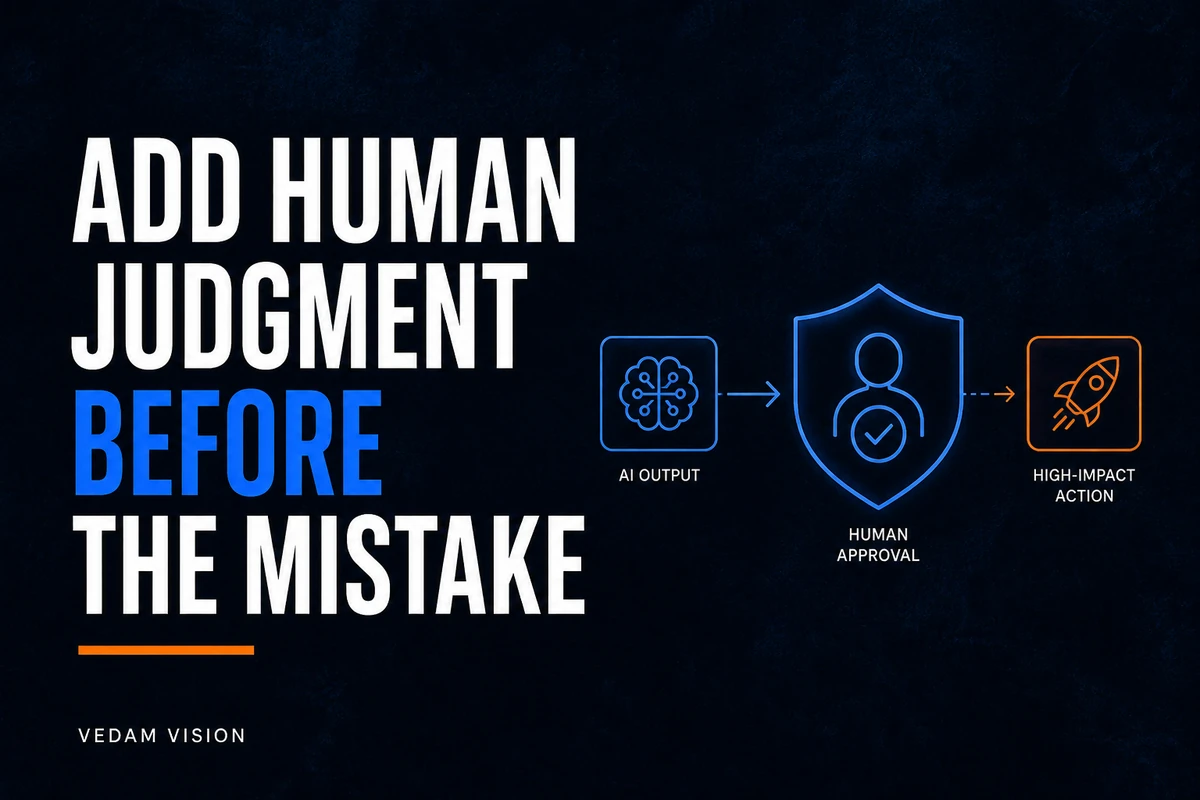
| 4. Add your expertise | Human | Insert specific examples, data, and your perspective | Draft + substance |
| 5. Polish for voice | Human | Rewrite opening, adjust tone, remove generic phrases | Published content |
Prompting AI Effectively for Marketing Content
The quality of AI output depends entirely on the quality of your input. Generic prompts produce generic content. Specific prompts produce specific content.
Bad prompt: "Write a LinkedIn post about email marketing"
Better prompt: "Write a LinkedIn post for the owner of Vedam Vision, a digital marketing agency in India, MP. The post shares the insight that most Indian small business owners think email marketing is dead because they've never built a quality list — and how a salon owner I worked with went from 200 to 1,800 subscribers in 90 days using just two tactics: an in-store QR code and a birthday offer. Tone: direct, practical, conversational. Length: 150-200 words with short paragraphs and a question at the end."
The second prompt produces content unique to Vedam Vision because you've provided specific context AI can't invent.
Content Types Where AI Adds the Most Value
- Drafting repetitive content: Social media captions, email sequences, FAQ page answers — high volume, formulaic structure
- Research summaries: Compiling information on a topic you'll then add expert perspective to
- Content outlines: AI is excellent at structure; you fill in the substance
- Editing and refinement: "Make this paragraph more conversational" or "suggest a stronger CTA"
Content Types Where AI Adds Least Value
- Thought leadership requiring original perspectives
- Content requiring specific local market knowledge
- Crisis communications requiring nuanced tone judgment
- Highly personalized client communications
Frequently Asked Questions
FAQ
Will Google penalize AI-generated content?
Google's position is that it penalizes unhelpful content regardless of how it was produced — including AI content that is generic, thin, or doesn't serve the searcher's needs. Well-edited, genuinely helpful AI-assisted content that demonstrates expertise is not penalized. The risk is from publishing unedited AI output at scale — thin, generic content that adds no value. Use AI as a production tool; ensure every published piece demonstrates genuine expertise and provides genuine value.
How do I train AI to write in my brand's voice?
You can't fully train an AI tool to understand your brand from scratch in a single session, but you can prompt it effectively. Include 2-3 examples of your best existing content in the prompt and ask it to match that tone. Describe your voice in adjectives: "direct but warm, technical but accessible, confident without being arrogant." Build a library of your best content examples and use them as reference points in every AI content session. This produces far more on-brand output than generic prompting.
Is there an AI tool specifically good for Indian business context?
ChatGPT, Claude, and Gemini (Google's AI) all have reasonable knowledge of Indian business context, but none are specifically trained for the Indian market. Practical workarounds: always specify the Indian context in your prompts ("for Indian SMEs in tier-2 cities," "in the Indian real estate market," "for a business in Madhya Pradesh"). Include Indian examples in your prompts when you want India-specific references. For Hindi or regional language content, Claude and Gemini currently handle Indian languages better than ChatGPT.