Quick answer
The 2026 Work Trend Index argues that as AI and agents take on more execution, people need stronger agency to direct work and own outcomes. For Indian SMEs, the practical shift is not replacing every role. It is redesigning tasks, delegation rules, review points, and skills so employees know what to hand to AI, what to verify, and what remains a human decision.
AI at work is moving beyond occasional drafting.
Employees are asking systems to research, analyse, prepare, coordinate, and sometimes act through connected tools. That changes more than productivity. It changes how work is assigned, reviewed, and owned.
Microsoft's official coverage of the 2026 Work Trend Index describes an "agency equation": as agents take on more execution, people can gain more room to direct work, make calls, and own outcomes. The research cited on that page surveyed 20,000 full-time or self-employed knowledge workers using AI at work across ten markets between February 18 and April 7, 2026.
The useful word is agency.
Automation without agency can leave employees supervising systems they do not understand. Agency means having the context, authority, skill, and responsibility to shape the result.
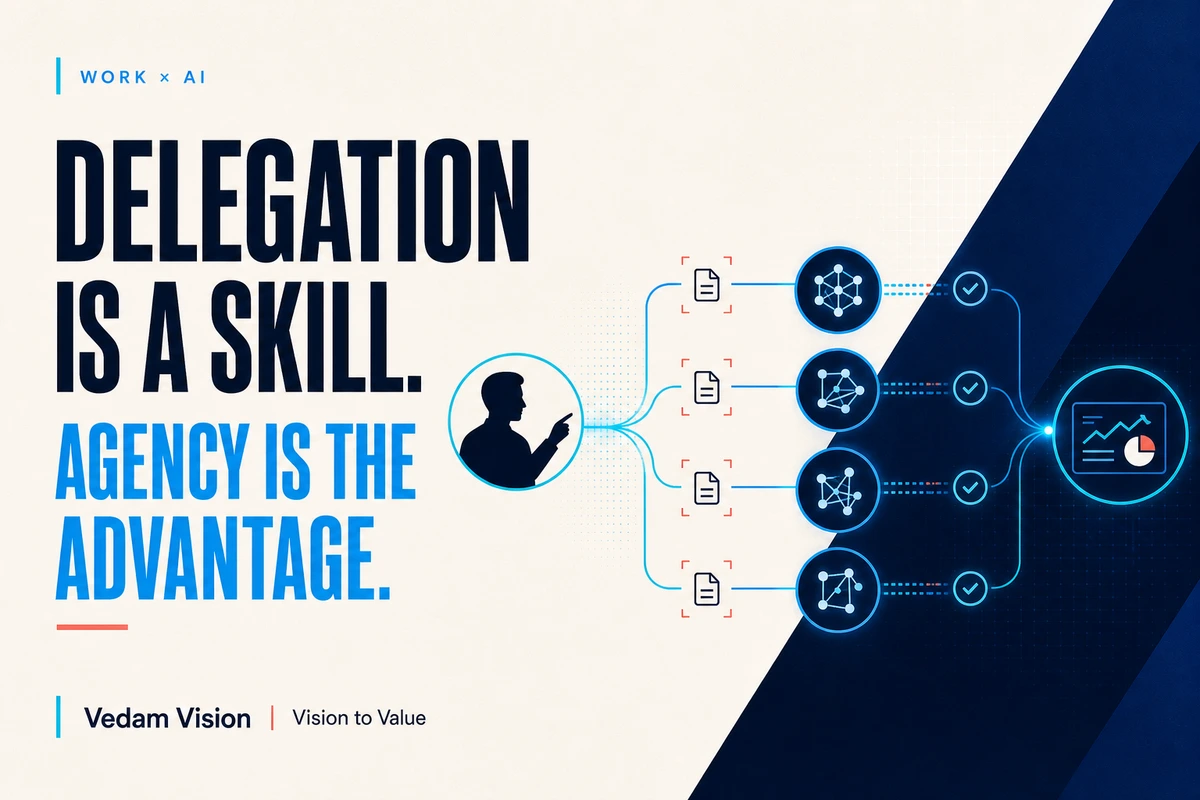
Delegation is becoming a core work skill
Managers already delegate to people. Delegating to AI requires some of the same clarity and some new controls.
A good delegation includes:
- objective
- relevant context
- constraints
- approved resources
- expected output
- decision rights
- review standard
- escalation conditions
"Analyse these sales calls" is not enough.
"Identify recurring objections from this month's approved transcripts, cite the source call, separate customer statements from interpretation, and flag any pricing promise for sales-manager review" creates a more accountable task.
The employee remains responsible for framing the work and judging the result.
From task doer to work director
Some roles will spend less time producing a first draft and more time directing a workflow.
A marketer may define the campaign idea, provide customer evidence, generate variations, choose the strongest, verify claims, and monitor response.
A sales executive may ask AI to prepare account context, summarise calls, draft follow-ups, and update a record after approval. The executive still manages the relationship and decides what to promise.
An operations coordinator may use an agent to gather status, identify exceptions, and prepare actions. The coordinator decides which exceptions need escalation.
The role does not disappear. Its centre of gravity changes.
Human agency needs explicit decision rights
Employees cannot own outcomes if they do not know which decisions are theirs.
For each AI-enabled workflow, define:
- what AI may suggest
- what AI may draft
- what AI may execute
- what always requires approval
- who can override the system
- who owns errors and corrections
- who can stop the workflow
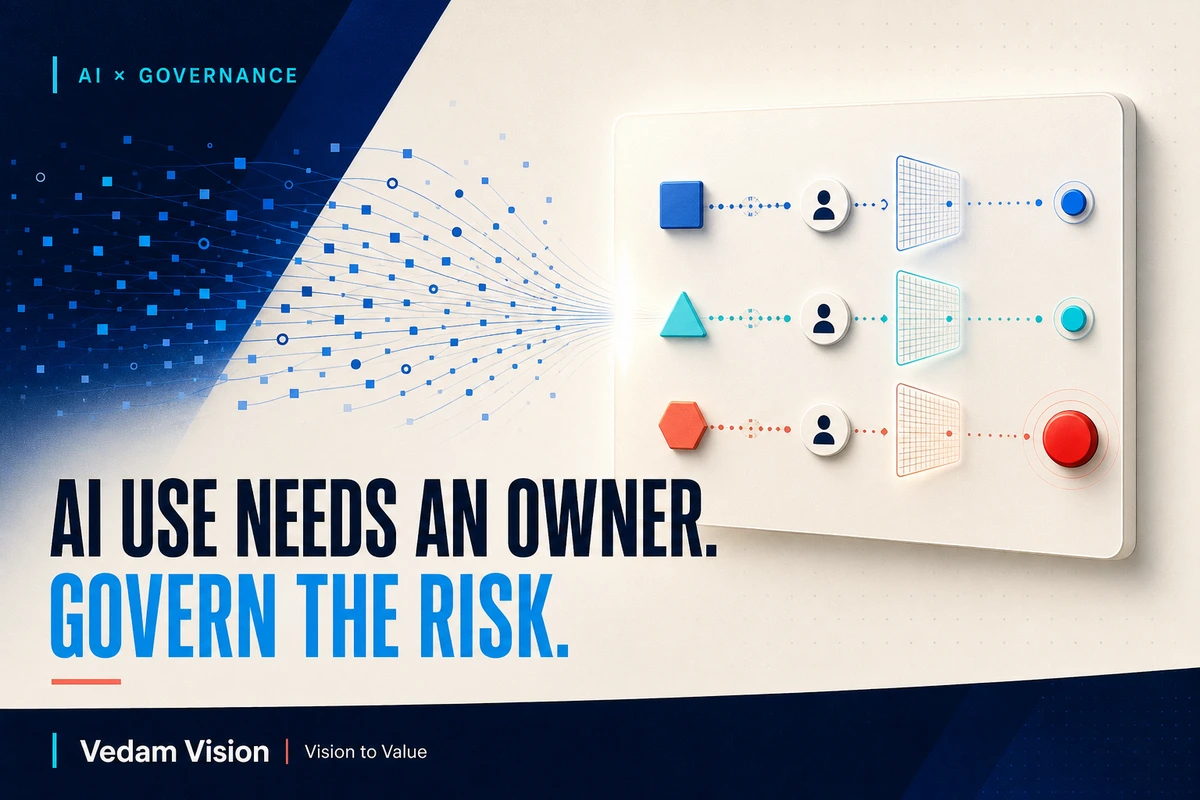
High-impact areas need stronger human authority. Hiring, pricing exceptions, payments, customer commitments, legal positions, health or safety, and access permissions should not be delegated casually.
Vedam Vision's article on AI governance for Indian enterprises is a useful companion for defining ownership, review, and risk controls.
Three types of AI-enabled roles
AI-assisted practitioner
The person performs the work with AI support.
Examples include a designer exploring variants, an accountant classifying documents for review, or a writer preparing a sourced outline.
The employee needs prompt and context skills, fact checking, domain judgment, and clear data rules.
AI workflow operator
The person runs a repeatable process that includes models, data, tools, and human gates.
Examples include a lead-enrichment workflow, support triage, content pipeline, or invoice exception process.
The operator needs monitoring, exception handling, version awareness, and basic evaluation skills.
AI work architect
The person redesigns how a team performs a business process.
They identify where AI helps, define boundaries, choose tools, set metrics, assign owners, and improve the workflow over time.
A small business may not use these job titles. The responsibilities still need owners.
Skills that become more valuable
Microsoft's partner summary of the 2026 Work Trend Index reports that survey respondents highlighted quality control of AI output and critical thinking among important human skills.
For an SME, six capabilities matter:
Problem framing
Define the real business problem before choosing the AI task.
Context assembly
Provide relevant, approved information without exposing unnecessary data.
Evaluation
Judge accuracy, completeness, usefulness, risk, and fit for the audience.
Tool judgment
Know when generation is enough and when the workflow needs retrieval, calculation, or a controlled system action.
Exception handling
Recognise when the normal path has failed and route the case to the right person.
Accountability
Own the final action and correction rather than blaming the model.
Redesign work at the task level
Do not start by asking which jobs AI will replace.
Break a role into tasks:
| Task type | AI role | Human role |
|---|---|---|
| Repetitive preparation | Gather, format, classify | Define rules and review exceptions |
| Pattern discovery | Surface themes or anomalies | Test meaning and choose action |
| Draft creation | Produce options | Set direction, verify, and approve |
| Customer interaction | Suggest response or next step | Manage trust and commitments |
| High-impact decision | Provide evidence and scenarios | Decide, document, and own outcome |
This approach shows where work changes without reducing a person to one task.
An Indian SME example
Consider a regional manufacturing supplier with a small sales team.
Before AI, each representative manually researches an account, reviews old emails, prepares meeting notes, drafts a follow-up, and updates the CRM.
An AI-enabled workflow could retrieve approved account history, summarise prior interactions, prepare questions, draft a follow-up, and suggest CRM fields.
Human agency remains essential:
- the salesperson chooses the relationship strategy
- pricing and delivery promises require authority
- the source record stays visible
- uncertain information is flagged
- the salesperson approves the message
- the CRM update is logged
The time saved can be used for customer conversation, solution design, and follow-through. That is useful only if the team actually redirects capacity toward higher-value work.
New management responsibilities
Managers need to inspect work systems, not only individual output.
Ask:
- Is the AI task clearly defined?
- Does the employee have the right context?
- Are tools and data approved?
- Is the review proportionate to risk?
- Can the person challenge or stop the system?
- Are errors visible?
- Is saved time creating useful capacity?
- Are employees learning or becoming dependent?
A faster workflow can still reduce resilience if nobody understands how it works.
Train with real work
Generic AI workshops create awareness. Skill grows through repeated work with feedback.
Choose one workflow. Show a good delegation, poor delegation, correct result, misleading result, and exception. Let employees compare outputs and explain their decisions.
Train managers to review the task design. Train employees to document failure. Reward people for catching a risky output, not only for using more AI.
Vedam Vision's guide to training Indian teams to use AI offers a practical route from tool exposure to workplace capability.
A 30-day role redesign pilot
Week 1: map
Choose one role and list recurring tasks, time, risk, inputs, outputs, and current pain points.
Week 2: delegate
Select one low or managed-risk task. Define the AI brief, context, tools, human gate, and owner.
Week 3: test
Run representative cases. Track quality, correction effort, cycle time, exceptions, cost, and employee confidence.
Week 4: decide
Keep, revise, or stop the workflow. Update the role description with the new responsibility, training need, and decision right.
Do not scale because the demo looked impressive. Scale when the work system is better.
Agency is the advantage
The 2026 Work Trend Index does not make delegation automatic or safe. It points to a more demanding form of work.
People need to direct systems, evaluate output, handle exceptions, and own consequences. Managers need to redesign roles and authority. Businesses need to measure whether saved effort becomes better service, decisions, or growth.
AI-enabled roles should not make people passive supervisors of machines.
They should give capable people more room to exercise judgment.
That is the opportunity behind human agency.
Frequently asked questions
What is the 2026 Work Trend Index?
It is Microsoft's annual research on how work is changing. The 2026 reporting focuses on AI, agents, human agency, and organisational redesign.
What does human agency mean in AI-enabled work?
It means people have the context, authority, skill, and responsibility to direct AI-supported work, challenge outputs, make decisions, and own outcomes.
Will AI-enabled roles replace existing jobs?
Some tasks and roles will change, but the effect depends on the work, industry, economics, and organisation. Businesses should analyse tasks rather than assume a single outcome for whole jobs.
Which skills should SMEs train first?
Start with problem framing, context handling, output evaluation, data rules, exception handling, and clear decision ownership in one real workflow.
How can a company measure whether role redesign works?
Track quality, cycle time, review effort, exceptions, cost, employee adoption, customer impact, and how saved capacity is used.