Quick answer
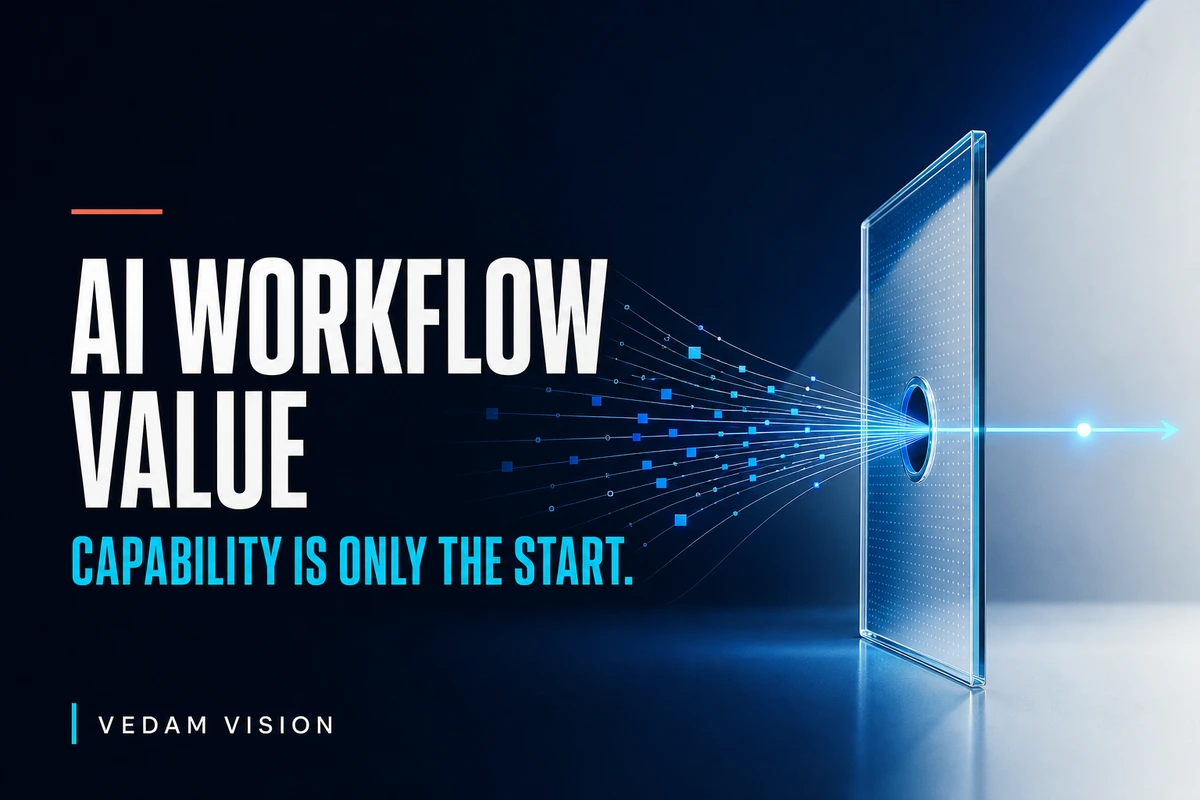
AI capability describes what a model or tool can do under certain conditions. AI workflow value describes whether that capability produces a reliable, affordable, and useful result inside a real business process. Evaluate tools with real tasks, acceptance criteria, end-to-end cost, review effort, latency, data needs, failure handling, and ownership. The best tool is the smallest dependable system that meets the workflow's standard, not automatically the model with the longest feature list.
A product launch can make every AI tool look essential.
The model reasons better. The context window is larger. It can use more tools, process more media, or produce a polished document. These capabilities matter, but they do not answer the operating question: will this improve a workflow your business cares about?
That question requires evidence from the work, not excitement from the release note.
Capability is potential
Capability tells us what a system may accomplish. It can include reasoning, coding, writing, retrieval, vision, tool use, speed, context handling, or structured output.
Benchmarks and demonstrations help compare systems, but they represent particular tests. Your company may need a different combination of accuracy, tone, privacy, latency, language support, integration, and cost.
An AI model that performs strongly on a difficult benchmark can still be a poor fit for a routine customer workflow. A smaller model can sometimes be the better operating choice when the task is well defined and the quality threshold is clear.
OpenAI's official practical guide to building AI agents recommends starting with capable models to establish a performance baseline. It then suggests testing smaller models to see whether they still achieve acceptable results, allowing teams to optimise cost and latency without guessing where quality will fail.
That is a useful buying discipline: establish what good looks like before optimising the system.
Workflow value is realised performance
Workflow value appears when a capability fits a sequence of real work.
Consider an enquiry qualification process. A tool may be able to summarise the customer's message. The workflow also needs to retrieve product context, identify missing information, apply qualification rules, write to the CRM, route an exception, and let a person review high-value opportunities.
If the summary is excellent but the CRM update fails, the workflow is weak. If the result needs ten minutes of correction, the time saving may disappear. If nobody owns exceptions, leads can be lost quietly.
Evaluate the whole path:
- input
- context
- model action
- tool action
- review
- exception
- accepted result
- business outcome
The model is one component. Value comes from the system.
Start with an acceptance standard
Do not begin a tool trial with “let us see what it can do.” Begin with a task and an acceptance standard.
For a proposal summary, the standard may require:
- every customer requirement captured
- no invented commitment
- pricing copied only from an approved source
- unresolved questions clearly flagged
- output delivered in the company template
- responsible salesperson approval before sending
These criteria turn preference into a test. They also reveal whether the task is suitable for automation.
OpenAI's article on how evals drive AI for businesses describes a cycle of specify, measure, and improve. It notes that broad model evaluations cannot reveal every nuance of a specific business workflow. Domain experts still need to define quality and review system behaviour.
Use representative examples
A clean demo is not a representative workload.
Build a test set from ordinary cases, difficult cases, incomplete inputs, unusual formats, and known failures. Remove or protect sensitive information where appropriate. The examples should reflect the language and messiness the team actually receives.
For an Indian SME, that may include mixed English and Hindi, scanned invoices, inconsistent product names, WhatsApp-style messages, local addresses, and customers who omit important details.
Test the same examples across candidate tools. Record accepted quality, correction time, failure type, and cost. A simple spreadsheet with a clear rubric can be more useful than a general impression after ten prompts.
Measure accepted output
Raw output volume is a weak success measure.
If a tool generates fifty product descriptions and twenty require substantial correction, the business did not receive fifty useful outputs. Measure what passes the acceptance standard.
Useful measures include:
- accepted result rate
- factual error rate
- average review time
- correction time
- exception rate
- end-to-end latency
- cost per accepted result
- customer or employee outcome
The purpose of measurement is not to create a complicated dashboard. It is to stop a fast first step from hiding cost later in the process.
Vedam Vision's guide to calculating AI ROI for Indian SMBs explains why time, quality, adoption, and business results need to be considered together.
Check context, tools, and instructions
The same model can perform very differently depending on the system around it.
OpenAI's agent guide identifies models, tools, and instructions as core components. A capable model without approved context may guess. A good model with a poorly defined tool may take the wrong action. A useful workflow with vague instructions may produce inconsistent outputs.
Audit each layer:
Context
Is the system using current, approved information? Can it distinguish policy from an old document? Are customer permissions respected?
Tools
Can the system retrieve, write, send, or update only what it is authorised to handle? Are actions logged? Can risky actions pause for approval?
Instructions
Are objectives, boundaries, output formats, and escalation rules explicit? Can another person understand why the system behaved as it did?
Capability becomes safer and more useful when the surrounding design is clear.
Compare cost at workflow level
Model price is only one cost.
Include implementation, integration, human review, correction, monitoring, security, training, and maintenance. Also count the cost of failure. A cheap model that creates frequent customer-facing errors can be more expensive than a higher-priced model with a better accepted result rate.
Cost should be measured per useful outcome. For example:
| Option | Model cost | Review | Accepted result | Workflow fit |
| Tool A | Low | High | Inconsistent | Weak |
| Tool B | Medium | Low | Reliable | Strong |
| Tool C | High | Medium | Excellent but slow | Suitable only for complex cases |
This may lead to a model ladder. Routine classification uses a fast model. Complex drafting uses a more capable model. High-risk decisions require a person.
Include failure handling
Every real workflow will meet an input it cannot handle.
Plan what happens when confidence is low, a tool call fails, required context is missing, or the output violates a rule. A system that fails visibly can be managed. A system that continues confidently can create silent risk.
Good failure handling may include:
- stop and ask for missing information
- retry a limited number of times
- route to a named owner
- preserve the original input
- record the reason
- prevent a partial action from being treated as complete
The OpenAI guide recommends human intervention for high-risk actions and when failure thresholds are exceeded. The same principle applies whether the company is building a complex agent or a small internal assistant.
Separate pilot excitement from adoption
A founder may love a tool that the team never uses. A team may use a tool often without improving an important outcome.
Check adoption with context:
- Who uses it?
- Which tasks moved into the new workflow?
- What old step disappeared?
- What new work appeared?
- Who maintains instructions and data?
- What happens when the model changes?
An AI workflow should have an owner, a measurement rhythm, and a decision about when to stop or redesign it.
Vedam Vision's article on why AI adoption breaks at the handoff examines the operational gap between generated output and accountable action.
A practical evaluation scorecard
For each candidate tool, score these areas from one to five:
- accuracy on representative examples
- accepted result rate
- review and correction effort
- latency for the real task
- total cost per accepted result
- data and security fit
- integration with existing systems
- failure visibility and recovery
- ease of ownership and maintenance
- measurable business effect
Write evidence beside every score. “Feels better” is not evidence. A test result, review time, failure log, or user observation is.
Choose the dependable workflow
Feature lists are useful for discovery. They are not a purchasing decision.
Start with the workflow. Define acceptance. Test representative cases. Measure accepted output. Include review, tools, context, failure handling, and total cost. Then choose the simplest system that meets the standard.
The most capable model may still win. The difference is that it wins because the workflow evidence supports it, not because the announcement created urgency.
Frequently asked questions
What is the difference between AI capability and workflow value?
Capability describes what a tool can do. Workflow value describes whether it delivers a reliable, useful, and affordable result inside a real business process.
Should a business always choose the most capable AI model?
No. Start with a strong model to establish the quality baseline, then test whether a smaller or faster model can still meet the acceptance standard.
How should an SME test an AI tool?
Use representative real examples, a written rubric, accepted result rate, review time, correction effort, total cost, and clear failure cases.
What is an accepted AI result?
It is an output that meets the workflow's factual, quality, format, safety, and approval requirements without unacceptable correction.
How often should an AI workflow be reviewed?
Review it regularly and whenever the model, data, instructions, tools, policy, or business process changes. Monitor failures continuously for high-impact workflows.