Quick answer
A funding announcement becomes a strategy lesson only when the capital is connected to a business constraint, capability, demand signal, milestone, and risk. Anthropic's May 2026 announcement says it raised $65 billion at a $965 billion post-money valuation and intends to support safety and interpretability research, compute, products, and partnerships. Smaller businesses should not copy the scale. They can study the allocation logic and require every major investment to explain what bottleneck it addresses and how progress will be measured.
Funding headlines create an easy illusion: more capital must mean a better strategy.
Capital creates options. It can finance capability, capacity, distribution, research, hiring, or survival. It can also increase pressure, complexity, dilution, fixed cost, and execution risk.
The useful question is not “how much did the company raise?” It is “what operating system is the capital meant to build?”
What Anthropic announced
In its official Series H announcement dated May 28, 2026, Anthropic says it raised $65 billion at a $965 billion post-money valuation. The company says the funding is expected to advance safety and interpretability research, expand compute, and scale products and partnerships.
The announcement also reports company figures about revenue, customer adoption, and infrastructure agreements. Those are self-reported statements from Anthropic. They are useful for understanding the company's explanation, but they should not be treated as independently audited proof unless additional evidence is available.
This article focuses on the allocation logic stated in the announcement, not on predicting Anthropic's valuation or future performance.
Lesson one: attach capital to a constraint
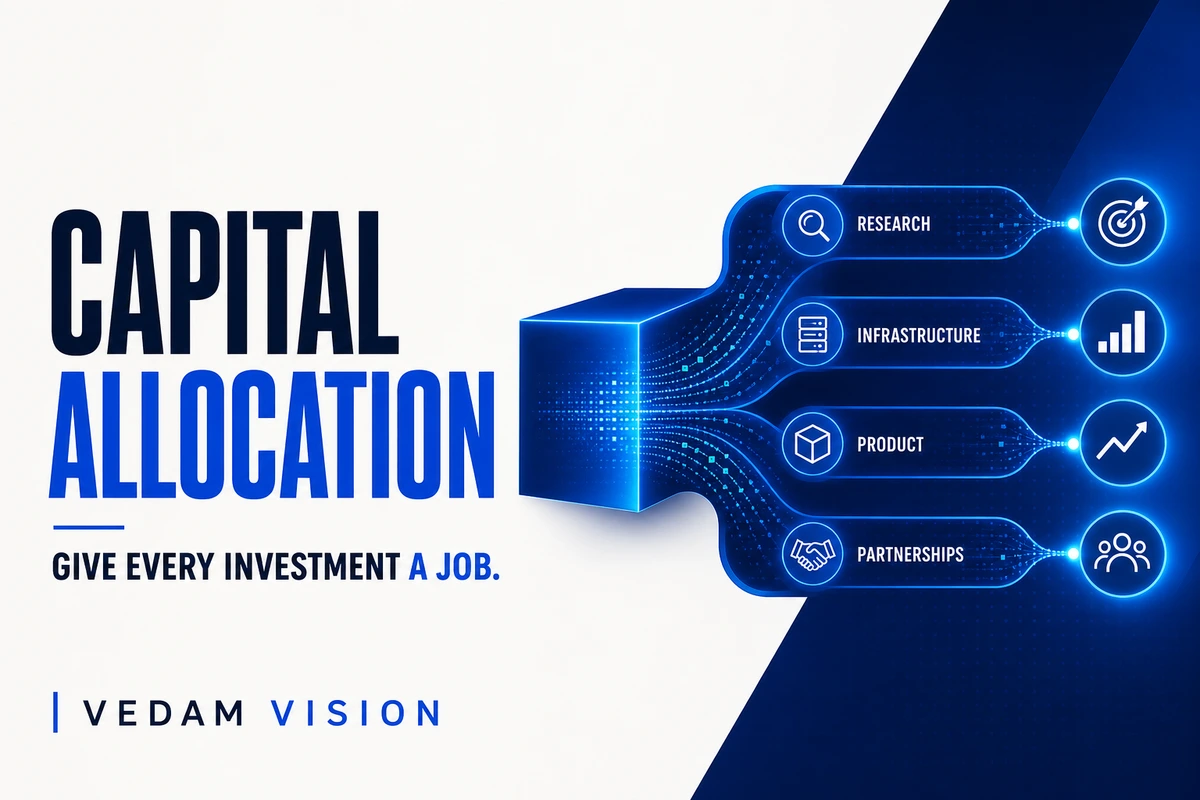
Money should have a job.
Anthropic's announcement connects capital to research, compute, products, and partnerships. These categories suggest constraints at the frontier AI level: expensive infrastructure, research intensity, product scaling, and distribution through major platforms.
An Indian SME has different constraints, but the discipline transfers.
Before making a major investment, write:
- the bottleneck
- evidence that it is the bottleneck
- the capability or capacity being purchased
- the expected operating change
- the owner
- the review date
If a manufacturer buys a machine while sales demand is the real constraint, capacity may sit idle. If an agency hires before clarifying its offer, more people may increase coordination without improving margin. If a retailer funds ads while fulfilment is unreliable, demand can expose the weakness faster.
Capital amplifies the system it enters.
Lesson two: capability and capacity are different
Capability is what the business can do. Capacity is how much it can do.
Research can create capability. Compute can create capacity. Products can turn capability into customer use. Partnerships can expand distribution and access.
A smaller company should separate these investments.
Examples of capability investment:
- new technical knowledge
- a stronger product
- a repeatable sales process
- a quality system
- proprietary data or workflow
Examples of capacity investment:
- more equipment
- more delivery staff
- more cloud usage
- additional locations
- larger inventory
Buying capacity before capability can scale an inefficient process. Building capability without a route to demand can create an impressive asset that nobody buys.
Lesson three: demand should guide expansion
Anthropic's announcement frames the raise against reported enterprise adoption and demand. Whether every reported figure develops as expected is a separate question. The operating principle is that expansion should respond to evidence, not only ambition.
For an SME, demand evidence may include:
- consistent qualified enquiries
- repeated customer requests
- high utilisation
- waiting lists
- lost sales caused by capacity
- strong renewal or reorder behaviour
- paid pilots converting into ongoing work
Interest is not the same as demand. Likes, survey enthusiasm, and verbal praise are weaker than deposits, contracts, usage, retention, and repeat orders.
Before investing, ask which signal proves that the constraint is real.
Lesson four: infrastructure is strategy when it changes reliability
Infrastructure can look like overhead until it becomes the condition for delivering the product.
Anthropic describes compute agreements and cloud availability as part of scaling Claude. For an AI company, infrastructure affects model development, product availability, cost, and resilience.
For a smaller business, infrastructure may include:
- power backup
- secure data systems
- production equipment
- warehouse software
- payment and billing systems
- standard operating procedures
- monitoring and recovery
The decision should connect infrastructure to an outcome such as lower downtime, faster delivery, better quality, increased capacity, or reduced risk.
Do not use “infrastructure” to hide an expensive purchase with no adoption plan.
Lesson five: distribution belongs in the capital plan
A product does not create value if customers cannot discover, buy, implement, or trust it.
Anthropic's announcement highlights availability across major cloud platforms and product partnerships. That is distribution infrastructure, not only technical infrastructure.
An SME may need to invest in:
- channel partners
- sales capability
- onboarding
- customer education
- search visibility
- reseller support
- service coverage
Founders often fund production first because it feels tangible. Distribution deserves the same operating attention.
Vedam Vision's article AI Is Not the Strategy. Better Decisions Are. offers a useful parallel: a tool or asset matters when it improves a decision and workflow connected to business value.
Lesson six: define milestones before spending
Every allocation should have a milestone.
Examples:
| Investment | Weak measure | Stronger operating milestone |
| New software | licences purchased | workflow adopted with accepted quality |
| New hire | role filled | defined capacity or capability transferred |
| Equipment | machine installed | reliable output at target quality and utilisation |
| Marketing | impressions | qualified pipeline and conversion evidence |
| AI workflow | prompts created | cost per accepted result and failure control |
The milestone should appear before the money is committed. Otherwise, the business may redefine success after the result is known.
Lesson seven: growth creates new risk
More capital and capacity change the company's risk profile.
Possible risks include:
- higher fixed costs
- dependency on partners
- security exposure
- quality drift
- slower decisions
- hiring dilution
- customer concentration
- infrastructure lock-in
- governance gaps
Anthropic's stated focus on safety and interpretability indicates that the company treats some risk work as part of capability building. A smaller business should also allocate resources to controls, training, maintenance, and recovery rather than funding only visible growth.
Vedam Vision's practical guide to AI governance for smaller businesses explains how ownership, approved use, data rules, review, and incident response can grow with adoption.
A capital allocation memo for an SME
Before a major spend, create a one-page memo.
1. Decision
What are we buying, building, hiring, or funding?
2. Constraint
Which bottleneck limits growth, quality, cash, service, or risk today?
3. Evidence
What customer, operational, or financial evidence shows that the constraint is real?
4. Capability or capacity
What will the business be able to do, or do more of, after the investment?
5. Milestone
Which measurable operating result should appear by a date?
6. Economics
What are the purchase, implementation, training, maintenance, and failure costs? How is the return expected to appear?
7. Risk
What new dependency or exposure does the investment create?
8. Stop or review condition
What result would cause the business to pause, reduce, or redirect the spend?
This memo creates discipline whether the source of capital is funding, debt, or retained profit.
Do not copy frontier economics
Anthropic operates in a capital-intensive frontier AI market. Its funding scale, infrastructure needs, investor expectations, and growth model are not a template for a design studio, manufacturer, retailer, or service company.
Avoid conclusions such as:
- every AI company needs massive capital
- a high valuation proves durable advantage
- enterprise adoption guarantees profitability
- funding means the technology is safe or complete
- smaller businesses should imitate the same spend mix
The transferable lesson is the reasoning structure, not the amount.
Evaluate self-reported company news carefully
Company announcements are primary sources for what a company says and what it officially announces. They are not independent analysis.
When using them:
- attribute claims to the company
- separate announcement facts from projections
- avoid adding unsupported causation
- check filings or independent sources when a decision requires stronger proof
- record the date
- do not assume reported momentum will continue
This creates a more useful business-news habit. Instead of repeating the headline, examine the operating claim and its evidence.
Connect money to a system
Funding is not strategy. Neither is debt, profit, or a large budget.
Strategy appears in the choices: which constraint receives capital, which capability is built, which market is served, which risk is accepted, and what the business refuses to fund.
Anthropic's 2026 raise provides a large example of stated allocation across research, compute, products, and partnerships. A smaller company can use the same categories as questions without pretending the businesses are comparable.
Give every rupee a job. Define the milestone. Measure the system after the spend. Be willing to redirect when the evidence changes.
That is how capital becomes an operating decision instead of a headline.
Frequently asked questions
How much did Anthropic say it raised in May 2026?
Anthropic's official announcement says it raised $65 billion at a $965 billion post-money valuation in its Series H round.
Does a large funding round prove a company has a strong strategy?
No. Funding creates resources and obligations. Strategy still depends on allocation, execution, demand, economics, risk, and choices.
What can an SME learn from a frontier AI funding announcement?
Study how capital is connected to constraints, capability, capacity, distribution, milestones, and risk. Do not copy the scale or assume the economics transfer.
What should a capital allocation memo include?
Include the decision, constraint, evidence, capability or capacity, milestone, full economics, risk, owner, and review or stop condition.
Are company funding announcements reliable sources?
They are primary sources for what the company officially says. Self-reported metrics and projections should be attributed and may need independent verification for high-stakes decisions.