Quick Answer
A useful meeting has a named decision, one accountable decision owner, the necessary evidence shared in advance, a clear boundary for discussion, and a written record of what will happen next. If the purpose is only to exchange updates, use an asynchronous format. AI can transcribe and summarise a conversation, but it cannot replace ownership, judgment, or commitment.
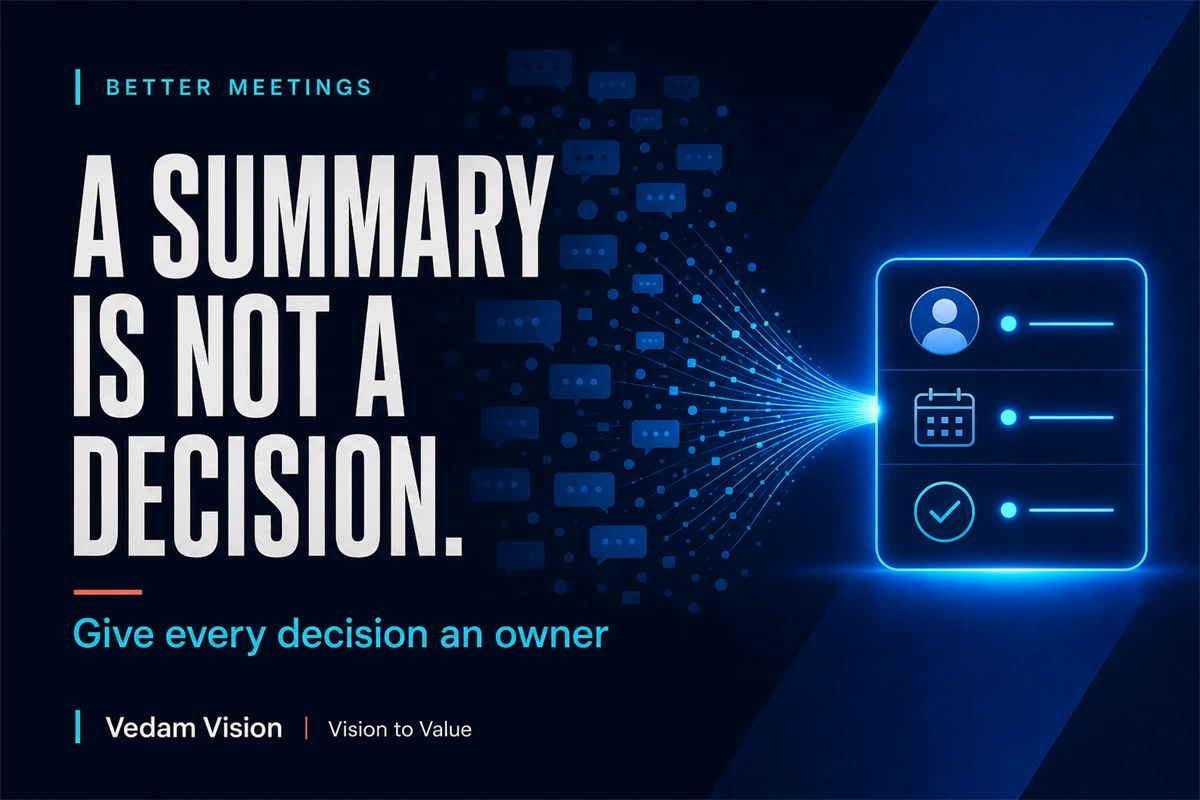
A meeting without a named decision owner is group note-taking.
The calendar invite is not the problem. The missing output is.
Teams often describe a meeting by topic: marketing sync, project check-in, strategy discussion, or AI review. A topic tells people what may be discussed. It does not tell them what must change by the end.
That ambiguity creates familiar results. Everyone contributes. The notes are detailed. The next step remains unclear.
Why Better Summaries Do Not Fix Weak Meetings
AI tools can create transcripts, summaries, action lists, and follow-up drafts. These capabilities are useful. They reduce administrative effort and make information easier to retrieve.
But a summary records what was said. A decision changes what happens next.
Microsoft's 2026 Work Trend Index puts growing emphasis on human judgment, clarity of intent, and responsibility as AI and agents take on more execution. The report's broader implication is relevant to meetings: organisations need to redesign work, not only accelerate existing activity.
If a meeting lacks a clear decision, faster notes preserve the ambiguity more efficiently.
This connects directly with the distinction that productivity is not the same as business leverage. Saving ten minutes on documentation matters less than removing an unnecessary meeting or resolving a decision that blocks several people.
Write the Decision Before the Invite
Use this sentence:
“At the end of this meeting, we will decide...”
Examples:
- which customer segment receives the next campaign
- whether the current AI pilot can move to limited production
- which launch scope fits the deadline and quality standard
- who owns a recurring delivery failure
- whether to stop, redesign, or continue a channel
If the sentence cannot be completed, the organiser may need more preparation or a different format.
Not every meeting must produce a final choice. Some produce a recommendation, risk review, or set of options for a named decision owner. The output should still be explicit.
Name One Decision Owner
The decision owner is accountable for making or accepting the final call.
This person should have the authority, information, and responsibility appropriate to the decision. The owner can invite expertise and dissent. Ownership does not mean ignoring input.
Avoid “the team will decide” when the consequences require one accountable person. Consensus can be a useful method, but it should not hide who owns the outcome.
Write the owner in the invite. If the owner cannot attend, decide whether the meeting should continue, change purpose, or move.
The article on three founder decisions that should stay human explains why accountability remains human even when tools assist analysis and execution.
Share Evidence Before the Conversation
A meeting is expensive when participants spend the first half discovering basic information together.
Send a short decision brief in advance:
- Decision to make
- Why it matters now
- Options
- Relevant evidence
- Constraints
- Known risks
- Recommendation when one exists
- Questions that need discussion
Keep the brief proportional to the decision. A one-page note is enough for many operating decisions. Complex or high-risk choices may need deeper material.
Evidence should be current and traceable. Link the source. Separate fact, assumption, and opinion. Do not bury the key tradeoff inside thirty slides.
Ask participants to review before the meeting. If they cannot, either change the expectations or reserve time deliberately. Pretending pre-reading happened creates a weak discussion.
Define the Boundary
Meetings expand when the group does not know what is open for debate.
State:
- What has already been decided
- What can still change
- Which constraints are fixed
- Which future decisions are outside scope
- What evidence would reopen the decision later
For example, a launch meeting may decide the feature scope, not reconsider the target audience or pricing model. A brand review may choose between two executions of an approved idea, not rewrite the business position.
Boundaries protect focus and prevent a local meeting from accidentally changing a larger commitment.
Choose the Right Meeting Type
Different outputs need different formats.
Decision meeting
Purpose: choose among prepared options.
Output: decision, reasoning, owner, next actions, review trigger.
Working session
Purpose: create or solve something together that benefits from live interaction.
Output: draft, solution, unresolved questions, owner.
Risk review
Purpose: identify failure conditions, controls, and acceptance boundaries.
Output: risk decisions, mitigations, owners, monitoring.
Retrospective
Purpose: turn completed experience into repeatable learning.
Output: changes to rules, process, ownership, or tools.
Update
Purpose: share status.
Default format: asynchronous unless discussion or immediate coordination is required.
The five-question weekly founder review offers a useful structure for turning reflection into changes in the next calendar.
Run the Meeting Around the Decision
Use a simple agenda:
- Restate the decision and owner.
- Confirm the shared facts and constraints.
- Surface the strongest disagreement or missing evidence.
- Compare the options against agreed criteria.
- Make or frame the decision.
- Record next actions and review conditions.
Do not begin with a long round of updates. Bring the most consequential uncertainty forward.
The facilitator protects the sequence and airtime. The decision owner protects the outcome. These roles can be held by the same person in a small meeting, but the distinction helps.
Make Disagreement Useful
Good meetings do not eliminate disagreement. They make it inspectable.
Ask participants to state:
- Which assumption they dispute
- Which evidence would change their view
- Which risk they believe is underweighted
- Which consequence they are protecting
Avoid personality labels and vague resistance. “I do not like this direction” is less useful than “This option depends on a customer behaviour we have not tested.”
The owner should record meaningful dissent when the decision carries risk. This helps the team review the outcome without rewriting history.
End With a Decision Record
Use a short template:
Decision: one sentence
Date: when it was made
Owner: accountable person
Reasoning: why this option was selected
Evidence: key sources or observations
Assumptions: what must remain true
Actions: owner and deadline for each
Review trigger: date or condition that may reopen the decision
The record prevents the same debate from restarting because someone forgot the context. It also helps new team members understand why the current process exists.
AI can help draft this record from the discussion. The owner should verify it before distribution.
Reduce the Number of Recurring Meetings
Recurring meetings often survive after their original purpose disappears.
Review them monthly:
- What decision or coordination does this meeting enable?
- Could the evidence be shared asynchronously?
- Has attendance expanded beyond necessary contributors?
- Does the same issue return without ownership?
- Can the frequency or duration be reduced?
- What would happen if the meeting stopped for one month?
Replace status meetings with a written update and an exception rule. Meet when a blocker, disagreement, risk, or decision genuinely needs synchronous attention.
Do not simply move the meeting burden into an unread reporting burden. Keep updates short, structured, and tied to action.
Create a Rule for Repeated Unresolved Decisions
When the same decision appears in three meetings, treat it as a structural problem.
Check:
- Missing owner
- Missing evidence
- Conflicting goals
- Authority gap
- Risk no one will accept
- Decision that has already been made but not communicated
- Avoidance of an uncomfortable consequence
Set a decision deadline and escalation path. More discussion is not automatically more responsible.
Use AI With a Clear Boundary
AI can support meetings by:
- Drafting a brief from approved sources
- Summarising evidence
- Suggesting questions or options
- Capturing a transcript with proper notice and permission
- Drafting actions and decisions for verification
- Comparing current discussion with prior records
It should not silently decide who is accountable or turn uncertain discussion into an authoritative conclusion.
Review privacy, consent, data handling, retention, and access before recording or sending meeting content to a tool. Sensitive customer, employee, legal, security, or financial discussions may need stricter controls or no external tool.
Measure Meeting Quality by Outcomes
Track a few practical indicators:
- Percentage of meetings with a named output
- Decisions made or advanced
- Actions completed by deadline
- Decisions repeatedly reopened
- Hours spent in recurring meetings
- Participant roles that were unnecessary
- Blockers removed
- Time from issue to accountable decision
Do not optimise only for shorter meetings. A focused sixty-minute risk review can be more valuable than four fast meetings that avoid the decision.
Final Takeaway
Meetings should exist because live interaction improves a decision, working result, risk review, or learning process.
Write the decision before the invite. Name the owner. Share evidence. Define the boundary. Record the result and review trigger.
Use AI to reduce administrative effort, not to hide missing accountability.
A summary tells the organisation what people said. A decision tells it what to do next.
Frequently Asked Questions
Does every meeting need to make a final decision?
No. A meeting may produce a recommendation, working draft, risk assessment, or options for a named owner. The required output should still be explicit.
Who should be the decision owner?
Choose the person with appropriate authority, accountability, information, and responsibility for the outcome. Input can be shared, but final ownership should be clear.
When should a status meeting become an update?
Use an asynchronous update when the purpose is information sharing and no live decision, conflict, exception, or coordination need justifies synchronous time.
Can AI write the meeting decision record?
AI can draft it from approved notes or a permitted transcript, but the decision owner should verify the wording, reasoning, actions, and sensitive information before distribution.
How can a team stop decisions from being reopened repeatedly?
Record the decision, owner, reasoning, evidence, assumptions, and review trigger. Reopen it only when the named condition occurs or material evidence changes.