Quick Answer
Saying no is strategic when it protects a more important outcome. Before accepting new work, identify the value it creates, the work it will delay, the owner it needs, the capacity it consumes, and the condition that would make you stop. A clear no preserves focus, quality, trust, and decision speed. A vague yes often creates hidden commitments the business notices too late.
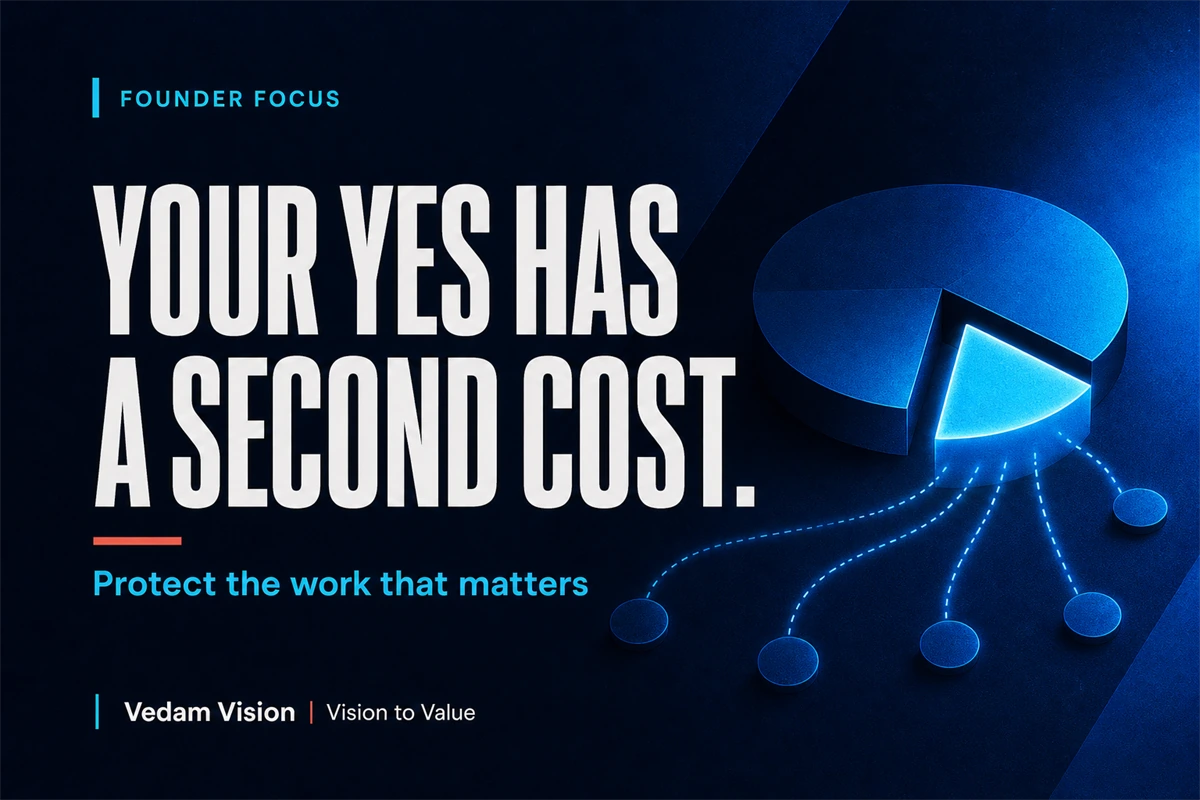
Every yes spends attention twice.
The first cost is visible. It is the meeting, project, hire, campaign, feature, or customer request the business accepts.
The second cost is quieter. It is everything that accepted work delays: a strategic decision, a quality review, a customer promise, a team member's development, or the uninterrupted time needed to solve a difficult problem.
Founders often evaluate only the first cost because the second does not arrive as an invoice. It arrives as fragmentation.
The strategic value of saying no is not refusal. It is the deliberate protection of limited attention.
Why More Capacity Does Not Remove the Need to Choose
Microsoft's 2026 Work Trend Index argues that as AI and agents take on more execution, human judgment, clarity of intent, and the design of work become more important. The report describes a future in which people increasingly direct, supervise, and own outcomes rather than merely complete tasks.
This creates an interesting tension. When tools make execution faster, teams can begin more work. But a business does not gain unlimited leadership attention, customer trust, review capacity, or decision quality.
Speed can increase the number of possible yeses. Strategy still requires choosing which yes deserves the organisation.
This is why productivity is not the same as business leverage. Completing more tasks matters only when the tasks improve an outcome that justifies the resources, risk, and coordination they consume.
A founder with ten active priorities does not have ten priorities. The founder has a queue of competing claims on attention.
The Four Hidden Costs Behind a Yes
1. Delay cost
Accepting one commitment moves another commitment later. The displaced work may have higher long-term value but less immediate visibility.
A custom client request may delay a reusable product improvement. A speaking opportunity may consume the week reserved for a difficult hiring decision. A new marketing channel may reduce the repetitions needed to learn from the current one.
Write down what moves if the answer is yes. If nothing moves, the business may be hiding the cost inside overtime, reduced quality, or an unrealistic plan.
2. Switching cost
New work creates new context. People need to understand the brief, coordinate decisions, track dependencies, and return to interrupted tasks.
Switching cost is especially high when the work requires founder input at several stages. A project that appears small in production may create repeated approval moments that fragment the week.
3. Quality cost
Capacity is not only the number of hours available. It includes the attention required to notice weak assumptions, review detail, and make careful exceptions.
When a team says yes beyond its review capacity, defects appear later. The project may technically ship while trust, usability, or brand consistency declines.
4. Dependency cost
Some yeses create permanent expectations. A one-time customer exception becomes a service standard. A founder approval becomes a recurring gate. A manual report becomes a weekly obligation.
Before accepting the work, ask whether the organisation can continue supporting the pattern it creates.
Say No to Protect a Named Outcome
A strategic no needs a positive reason.
“We are too busy” describes a condition. “We are protecting the August launch and will not add custom work until the critical customer journey is stable” explains a decision.
Name what the no protects:
- A customer outcome
- Product reliability
- Cash discipline
- A strategic market focus
- Team health
- A quality standard
- A committed deadline
- A learning cycle that needs enough repetitions
The protected outcome should appear in the calendar, budget, or decision log. Otherwise, the no may simply preserve unexamined habits.
This is related to three founder decisions that should stay human. Tools can provide information and options, but accountability for positioning, promises, and exceptions remains a human responsibility.
A Five-Question Decision Filter
Use this filter before accepting a meaningful new commitment.
What outcome does this create or protect?
State the expected change in plain language. Avoid “strategic,” “important,” or “good exposure” without a mechanism.
For example: the project reduces repeated support work, increases confidence in a high-value sales conversation, or removes a delivery risk affecting current customers.
What moves later if we accept it?
Name the displaced work. If the answer is “nothing,” check whether the plan assumes overtime or hidden multitasking.
The comparison should include timing and consequence, not only effort. Delaying a cash-collection improvement may cost more than postponing a low-risk internal redesign.
Who owns the decision and the result?
Do not accept ownerless work. A project needs one accountable person who can decide, coordinate, and report the result.
If every question returns to the founder, include that dependency in the cost.
What is the minimum excellent version?
Sometimes the right answer is not no. It is a smaller yes.
Reduce the number of channels, customer segments, features, meetings, formats, or approval steps while preserving the mechanism that creates value.
The minimum excellent version should still solve the real problem. A cheaper version that cannot work is not disciplined scope. It is delayed disappointment.
What would make us stop?
Define a review date and stopping condition. Without these, experiments become permanent commitments.
The stopping condition may be a missed quality threshold, insufficient customer response, unacceptable cost, unresolved risk, or a dependency that does not improve.
Distinguish Four Different Noes
Not every refusal means the same thing.
Not now
The idea has value but conflicts with a more important current commitment. Give a specific review date and explain what must be true then.
Not this version
The desired outcome is valid, but the proposed scope, channel, price, timeline, or method is wrong. Offer a smaller or safer version.
Not us
The work does not fit the company's position, capability, economics, or responsibility. A clear decline protects both parties from a poor fit.
Not anymore
The work once made sense but no longer earns its place. This may apply to a service, meeting, report, feature, marketing channel, or customer exception.
Stopping existing work is often harder than rejecting new work because identity and sunk cost are involved. Use evidence, not embarrassment, to decide.
Build a Stop List, Not Only a Priority List
Priority lists are easy to expand. Stop lists create capacity.
Review recurring work monthly. Ask:
- Which meetings do not produce decisions?
- Which reports are not used?
- Which approvals can move to a clear standard?
- Which channels have not produced a useful learning or result?
- Which customer exceptions repeatedly damage planned work?
- Which tools create more checking than time saved?
For each item, choose one action: remove, reduce, automate, delegate, redesign, or retain with a clear reason.
The five-question weekly founder review provides a useful place to identify work that consumes time without changing an outcome.
How to Say No Without Damaging Trust
A careless no can feel dismissive. A vague yes damages trust later.
Use four parts:
- Acknowledge the request and the underlying need.
- State the decision plainly.
- Explain the constraint or protected priority briefly.
- Offer a realistic alternative only if one exists.
For example:
“The request makes sense, but we will not add this variation before launch because it would delay testing the core journey. We can review it after two weeks of live usage data.”
Do not create false hope with “maybe later” when the work is a poor fit. Do not overexplain until the decision sounds negotiable. Clarity is more respectful than prolonged uncertainty.
Give Teams Permission to Escalate Competing Yeses
Focus cannot depend on founder discipline alone.
Teams need a visible priority order and permission to say when a new request conflicts with it. A simple rule helps: no new priority enters the plan without naming what leaves, moves, or loses capacity.
This turns conflict into a decision rather than a hidden burden.
It also prevents “urgent” from becoming a status claim. Urgency should have a consequence and deadline. Important work should have a named outcome. Everything else waits in an explicit queue.
Final Takeaway
Saying no is not a celebration of scarcity. It is how a business gives its strongest commitments enough attention to become real.
Before accepting new work, name the outcome, displaced priority, owner, minimum excellent scope, and stopping condition. Review recurring work for commitments that no longer justify their cost.
Every yes spends attention twice. Make sure the second cost is visible before you agree.
Frequently Asked Questions
How can a founder know when to say no?
Say no when the work does not support a named outcome, displaces a more valuable commitment, lacks an owner, creates unacceptable risk, or cannot be executed to a credible quality standard.
Is saying no always better than delegating?
No. Delegate when the work is valuable, the outcome and standard are clear, and someone has the capability and authority to own it. Do not delegate work that should not exist.
What is a “smaller yes”?
It is a reduced scope that preserves the value mechanism while limiting channels, features, formats, audiences, or approval steps. It should still be capable of solving the core problem.
How should a founder decline a customer request?
Acknowledge the need, state the decision clearly, explain the relevant constraint or priority briefly, and offer a realistic alternative only when the alternative can be supported well.
How often should a business review its commitments?
Review active priorities weekly and recurring work monthly. Larger services, product lines, channels, and operating commitments may need a quarterly strategic review.