Credibility does not require pretending that every issue is settled. It requires showing what you know, what you are testing, and what would change your view. This article turns that idea into a practical operating choice for founders and small teams, using current official evidence without presenting a company forecast as a universal fact.
Polish is no longer proof
Canva's 2026 essay on moving from polish to presence argues that professional-looking output is now widely accessible. The differentiator moves toward intention and visible evidence of thought. For a founder, that means the reasoning behind a position can carry more trust than a perfectly packaged conclusion.
This is not permission to publish every half-formed reaction. The useful version has a clear boundary: state the current position, show the evidence behind it, and name what is still unresolved. Readers can then judge the thinking instead of being asked to accept confidence as proof.
Separate uncertainty from vagueness
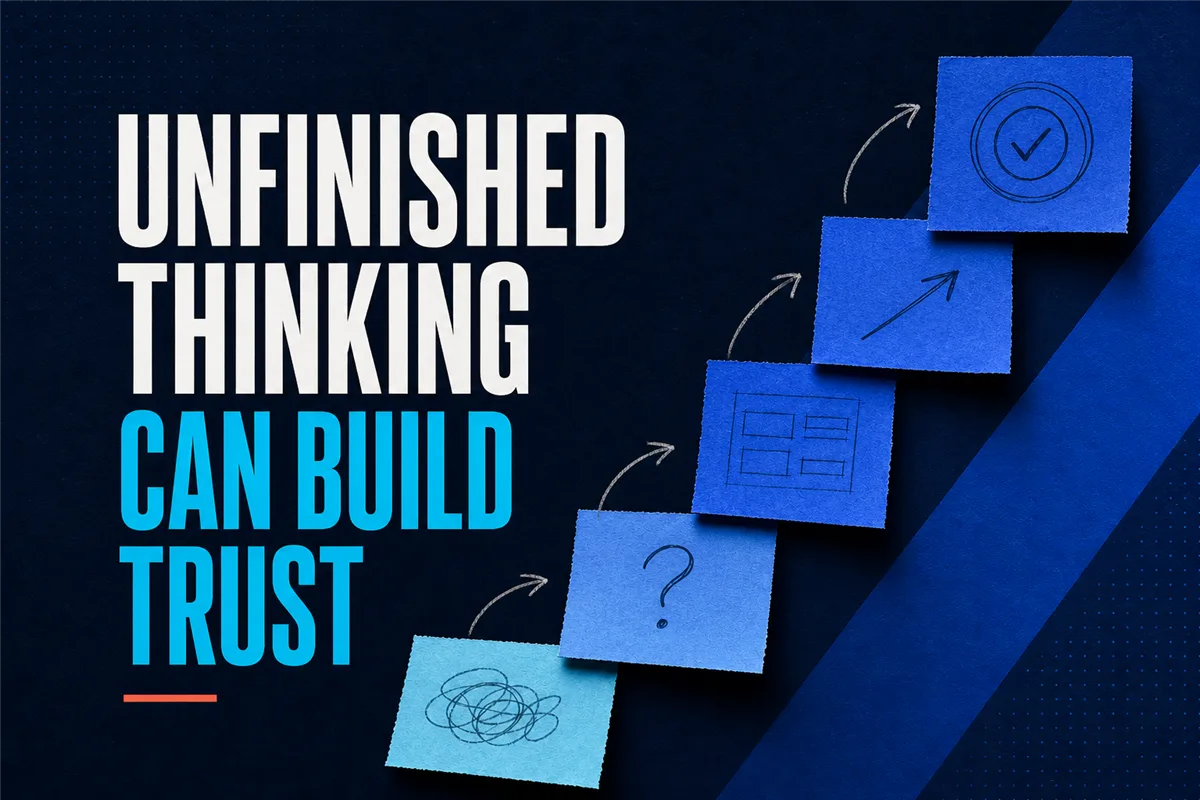
Uncertainty is specific. It can say which assumption remains untested, which customer group is missing, or which cost is still unknown. Vagueness simply avoids the decision. A credible unfinished view narrows the unknowns and explains why the available evidence is still good enough for a provisional action.
Use three labels in a working note: known, believed, and testing. Known points need evidence. Beliefs need an owner and a reason. Tests need a date or observation that will resolve them. This turns intellectual honesty into an operating habit rather than a personal style.
Show the path, not the theatre
Visible thinking earns trust when it helps another person make a better call. Screenshots of messy notes or dramatic confessions do not automatically create authenticity. The substance is the path from question to evidence, from evidence to position, and from position to a practical next step.
A founder discussing an AI pilot could say that response time improved, review effort remains high, and broader rollout will wait until two exception types are handled. That is unfinished, but it is useful. It tells the team what changed, what did not, and what the next decision depends on.
Where openness creates risk
Not every uncertainty belongs in public. Customer information, employee matters, security gaps, negotiations, and unverified accusations require restraint. Transparency is not the same as disclosure without judgment. The audience needs enough context to understand the business lesson, not access to every sensitive detail.
Before publishing, ask whether the unfinished point could harm a person, expose confidential information, or be mistaken for a factual allegation. If so, generalise the mechanism, remove identifying details, or keep the reflection inside the team until the facts are settled.
Turn changing your mind into evidence
A changed position can strengthen credibility when the reason is visible. Record the original assumption, the new evidence, and the operational consequence. This prevents the update from looking like a fashionable reversal and shows that the business can learn without hiding the earlier view.
The useful metric is not applause for vulnerability. Look for better questions, relevant saves, thoughtful replies, and decisions improved by the explanation. Those signals indicate that the audience found the reasoning usable, not merely emotionally appealing.
A founder publishing checklist
Before posting, write the current conclusion in one sentence. Add the strongest supporting evidence, the most important limitation, and the next test. Remove any claim that is more confident than its source. End with a question that invites experience or counter-evidence rather than generic agreement.
This format protects both candour and authority. The founder remains decisive about the next action while staying open about what may change. That is the balance false certainty cannot offer: a position strong enough to act on and honest enough to revise.
Putting unfinished thinking into practice
A founder is deciding whether to standardise an AI workflow across sales, support, and operations after one promising pilot. Begin by writing the actual choice in plain language. The goal is not to document every possibility. It is to make the owner, consequence, constraint, and next action visible to the people who must execute or review the work.
Use the official source as evidence for the specific signal it reports: Canva argues that when polished production becomes common, visible evidence of thought and intention becomes a stronger differentiator. Keep that attribution close to the claim. Do not turn a product announcement, platform recommendation, or company study into a universal prediction about every organisation.
Make the operating rule explicit: publish the strongest current position while naming its limits. Give the rule an exception path. Someone should know when routine execution must stop, which context must be added, and who has authority to accept a tradeoff.
Test the rule on a small but real piece of work. Use representative content and include one difficult case, because an easy example will not reveal whether the guidance survives pressure. Ask the next person in the workflow to explain the intent back in their own words.
Review quality of replies, saved posts, and decisions improved. Record the baseline, the review effort, and the reason an output was accepted or rejected. A fast first draft is not an efficiency gain if senior people spend more time repairing it or if the work weakens customer trust.
After several uses, keep the decisions that reduce confusion and remove the documentation nobody consults. Add an example only when it resolves a recurring ambiguity. The finished system should make good judgment easier, not make a small team feel as if it is operating a large compliance department.
This approach also gives AI better context. Instead of asking for generic best practice, provide the audience, source pack, rule, boundary, and acceptance test. Require the output to flag missing evidence. Human review can then focus on the decision that matters rather than cosmetic correction.
Write one short decision record after the review. Capture what the team chose, why it chose it, which evidence mattered, and what would trigger another review. This small record prevents the next project from reopening settled questions while leaving a clear path for change when the context or evidence genuinely moves.
Finally, explain the rule to someone who did not help create it. If that person cannot apply it to a realistic case, the guidance still depends on hidden context. Improve the example, boundary, or ownership until the decision can travel without requiring the founder to repeat the original conversation.
Related Vedam Vision reading
Frequently Asked Questions
What does unfinished thinking mean in practice?
It means publish the strongest current position while naming its limits. The exact workflow should match the consequence, ambiguity, and reversibility of the decision.
How should a small team start?
Choose one real workflow, document the baseline, define one owner and one acceptance test, then run a contained pilot before scaling.
Where should AI be used?
Use AI for research support, drafting, comparison, transformation, and repeatable execution where sources and outputs can be reviewed. Keep human ownership for positioning, exceptions, and consequential decisions.
Which metrics matter most?
Track quality of replies, saved posts, and decisions improved. Include review effort and rework so a fast draft is not mistaken for an efficient workflow.
How do we keep the result credible?
Separate facts, assumptions, and opinions. Link factual claims to reliable sources, label uncertainty, and name the person who approves the final outcome.
The practical conclusion
Credibility does not require pretending that every issue is settled. It requires showing what you know, what you are testing, and what would change your view. The next move is small and concrete: choose one decision, expose the evidence and tradeoff, give it an owner, and review whether the outcome improved. Keep the source attached to current factual claims and keep opinion clearly framed as opinion. Revisit the rule after real use, because the purpose is not to defend the first framework. It is to help the team make a sound choice with less confusion and more accountable speed. That is how a useful idea becomes a repeatable business capability.