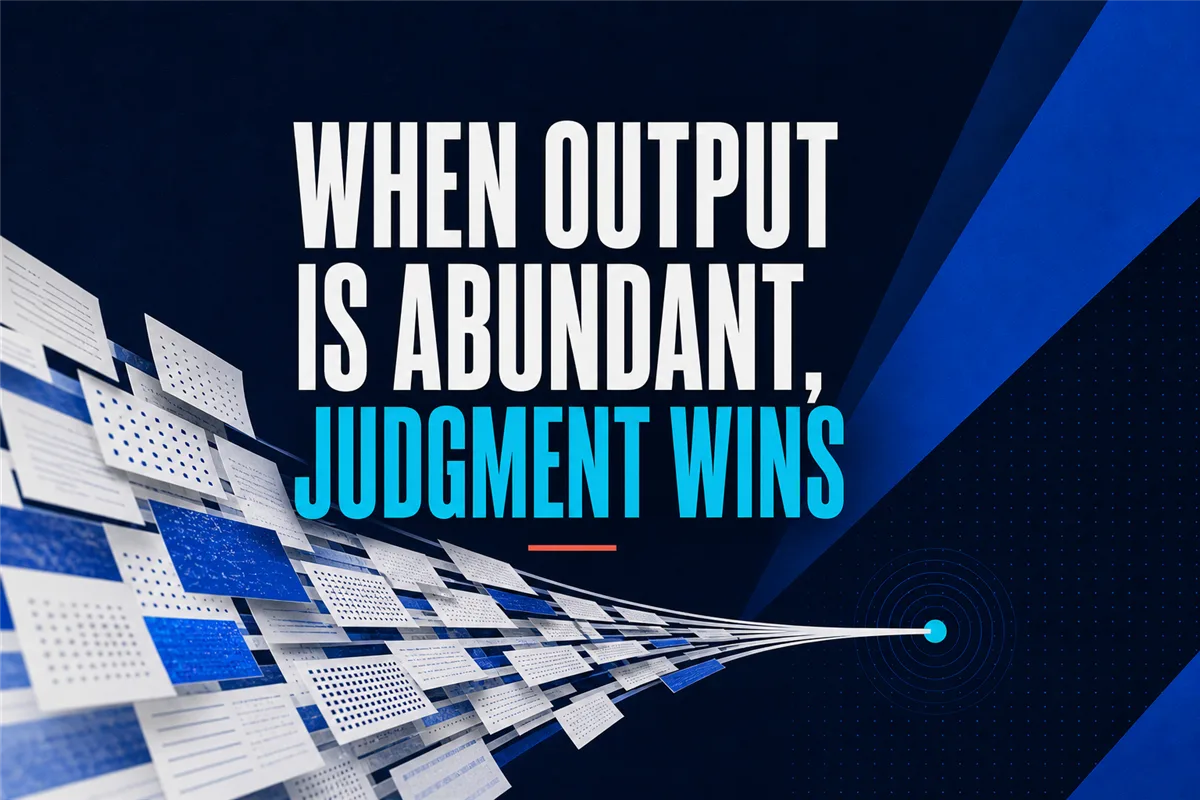
When production becomes abundant, judgment becomes scarce because deciding what deserves to exist remains harder than generating another option. This article turns that idea into a practical operating choice for founders and small teams, using current official evidence without presenting a company forecast as a universal fact.
Abundance changes the bottleneck
Microsoft's 2026 Work Trend Index reporting emphasises human agency, intent, judgment, and quality control in AI-enabled organisations. When agents can execute more work, the scarce capability shifts toward directing and evaluating that work.
A team can now produce more proposals, analyses, and creative options than leaders can inspect. The bottleneck is no longer the blank page. It is deciding which work deserves attention and which result is safe and useful.
Problem framing becomes a core skill
A weak question generates polished irrelevance. People need to define the decision, audience, constraints, evidence, and acceptable tradeoff before delegating. This is not prompt decoration. It is management work.
Train teams to convert requests into decision briefs. 'Analyse sales' becomes 'identify two reasons repeat purchases fell in the last quarter, using these approved data sources, and show uncertainty.'
Evaluation needs explicit criteria
Taste and confidence are poor review systems. Define correctness, completeness, source quality, brand fit, risk, and actionability before the output arrives. Criteria make it easier to compare versions and explain a rejection.
For recurring work, keep examples of accepted and rejected outputs with reasons. These become training material for people and context for AI systems.
Exception handling separates demos from operations
Routine cases make automation look easy. Exceptions reveal whether the organisation knows who owns the outcome. Define which conditions stop automation, which person receives the case, and how the decision returns to the workflow.
A customer complaint involving safety, a payment anomaly, or a policy conflict should not stay in the same lane as a standard request. Judgment is valuable because the business context changes the correct action.
Authority must follow accountability
People cannot own outcomes if they lack permission to challenge or stop AI-assisted work. Give reviewers clear authority, accessible evidence, and enough time to examine consequential outputs.
Avoid making every employee a final approver. Assign authority at the level where context and consequences meet, then record the decision so the system can improve.
Invest in the scarce layer
As generation costs fall, shift training toward framing, domain knowledge, critical evaluation, communication, and decision ownership. These skills help teams use any model and remain valuable as tools change.
Measure decision cycle time, accepted work, exceptions, review effort, and value created. More output is only useful when the organisation can select, trust, and act on it.
Putting human judgment in AI into practice
An SME can now generate dozens of proposals, campaign variants, and reports, but leaders have not defined who evaluates or approves them. Begin by writing the actual choice in plain language. The goal is not to document every possibility. It is to make the owner, consequence, constraint, and next action visible to the people who must execute or review the work.
Use the official source as evidence for the specific signal it reports: Microsoft's 2026 Work Trend Index reporting emphasises human agency, clear intent, judgment, and quality control as organisations adopt AI and agents. Keep that attribution close to the claim. Do not turn a product announcement, platform recommendation, or company study into a universal prediction about every organisation.
Make the operating rule explicit: invest in framing, evaluation, exception handling, and ownership. Give the rule an exception path. Someone should know when routine execution must stop, which context must be added, and who has authority to accept a tradeoff.
Test the rule on a small but real piece of work. Use representative content and include one difficult case, because an easy example will not reveal whether the guidance survives pressure. Ask the next person in the workflow to explain the intent back in their own words.
Review decision cycle time, accepted work, exceptions, and value created. Record the baseline, the review effort, and the reason an output was accepted or rejected. A fast first draft is not an efficiency gain if senior people spend more time repairing it or if the work weakens customer trust.
After several uses, keep the decisions that reduce confusion and remove the documentation nobody consults. Add an example only when it resolves a recurring ambiguity. The finished system should make good judgment easier, not make a small team feel as if it is operating a large compliance department.
This approach also gives AI better context. Instead of asking for generic best practice, provide the audience, source pack, rule, boundary, and acceptance test. Require the output to flag missing evidence. Human review can then focus on the decision that matters rather than cosmetic correction.
Write one short decision record after the review. Capture what the team chose, why it chose it, which evidence mattered, and what would trigger another review. This small record prevents the next project from reopening settled questions while leaving a clear path for change when the context or evidence genuinely moves.
Finally, explain the rule to someone who did not help create it. If that person cannot apply it to a realistic case, the guidance still depends on hidden context. Improve the example, boundary, or ownership until the decision can travel without requiring the founder to repeat the original conversation.
Related Vedam Vision reading
Frequently Asked Questions
What does human judgment in AI mean in practice?
It means invest in framing, evaluation, exception handling, and ownership. The exact workflow should match the consequence, ambiguity, and reversibility of the decision.
How should a small team start?
Choose one real workflow, document the baseline, define one owner and one acceptance test, then run a contained pilot before scaling.
Where should AI be used?
Use AI for research support, drafting, comparison, transformation, and repeatable execution where sources and outputs can be reviewed. Keep human ownership for positioning, exceptions, and consequential decisions.
Which metrics matter most?
Track decision cycle time, accepted work, exceptions, and value created. Include review effort and rework so a fast draft is not mistaken for an efficient workflow.
How do we keep the result credible?
Separate facts, assumptions, and opinions. Link factual claims to reliable sources, label uncertainty, and name the person who approves the final outcome.
The practical conclusion
When production becomes abundant, judgment becomes scarce because deciding what deserves to exist remains harder than generating another option. The next move is small and concrete: choose one decision, expose the evidence and tradeoff, give it an owner, and review whether the outcome improved. Keep the source attached to current factual claims and keep opinion clearly framed as opinion. Revisit the rule after real use, because the purpose is not to defend the first framework. It is to help the team make a sound choice with less confusion and more accountable speed. That is how a useful idea becomes a repeatable business capability.