The strongest service page answers the question a buyer is afraid to ask. That tension matters because a growing number of teams are adding tools, channels, and automated steps faster than they are improving the decisions around them. The result can look modern while the underlying work stays slow, fragile, or difficult to explain.
This guide turns high converting service page into a practical operating choice. It separates the current source signal from interpretation, then shows how an Indian SME, founder-led company, or lean delivery team can test the idea without making a large promise first.
Why this topic matters now
The useful question is not whether the idea sounds current. The useful question is whether it changes a real customer journey. A business creates value when work reaches an acceptable outcome with less delay, less confusion, or better control. It does not create value merely by adding another tool to the stack or another metric to a report.
For a smaller company, this distinction is especially important. The same person may be selling, approving, troubleshooting, and speaking with customers. A system that creates extra review work can consume the capacity it was meant to release. A campaign that attracts attention but weakens buying confidence can produce activity without progress.
The starting point for high converting service page is therefore a business sentence, not a technology sentence. Write who needs what outcome, what currently blocks it, and what would count as a better result. That sentence becomes the boundary for research, design, implementation, and measurement.
The source signal and the practical interpretation
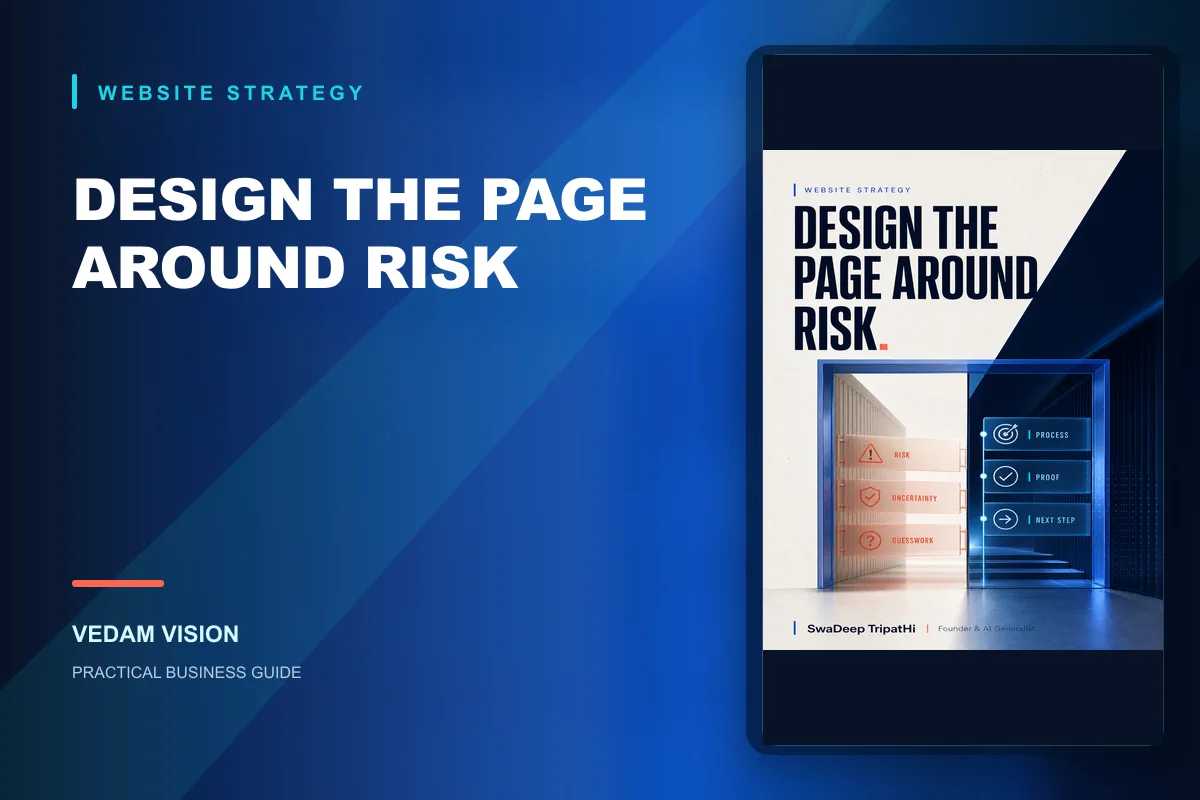
The strongest service page answers the question a buyer is afraid to ask.
Usually it is not, "What features are included?"
It is:
- Will this team understand my business?
- What happens if the scope changes?
- How will I know the work is progressing?
- Who owns the final result?
- What could go wrong?
A good service page reduces that uncertainty with a clear process, boundaries, examples, responsibilities, and a sensible next step.
Design supports this work, but design cannot replace it.
When Vedam Vision plans a service page, the goal is not to fit more claims above the fold. It is to help the right customer understand the decision.
If your service page looks polished but serious prospects still ask basic questions, the information architecture may be the real problem.
The Vedam Vision service page linked for this topic describes the practical capability behind the recommendation. It is commercial context, not independent evidence. The operating guidance below is therefore presented as a method to test, not as a universal performance claim.
The practical interpretation is narrower than the headline. A source may describe a product release, a platform direction, a market programme, or a current operating recommendation. It does not prove that a particular tool, channel, or workflow is right for every company. The business still needs to test fit, consequence, ownership, and measurable value.
That separation protects credibility. It also improves decision quality. Teams can discuss the evidence without pretending the source answered their implementation questions, and they can disagree with the interpretation without changing the underlying facts.
The customer-confidence test
Use five fields to turn the idea into an operating plan:
| Field | Question | What good looks like |
|---|---|---|
| Problem | What delay, risk, or missed opportunity are we addressing? | One specific problem stated without naming a tool |
| Owner | Who is accountable for the final result? | One website owner with authority to approve or stop |
| Context | Which information and rules are required? | Approved sources, boundaries, and a known update process |
| Control | When must the system pause or involve a person? | Visible exception and escalation rules |
| Outcome | How will we decide whether the change helped? | A baseline plus two or three decision-grade measures |
Begin with the problem field. Teams often jump to a solution because a demonstration makes the future feel concrete. But a clear problem statement is more valuable than a long feature list. It keeps the pilot useful even if the preferred tool or channel changes.
Ownership comes next. A shared responsibility label usually means nobody is watching the difficult cases. Name the person who can accept a tradeoff, reject a weak result, and update the rule. That person does not need to perform every step. They do need to remain answerable for the outcome.
Context is the material the customer journey needs to work. It can include approved product information, customer questions, brand rules, policies, page content, campaign history, or structured operational data. Context should have an owner and a date. Otherwise, a system can execute yesterday's truth with today's speed.
Control describes the stopping conditions. The common risks for this topic include message mismatch, missing proof, mobile friction, and unclear ownership. Write a response for each. A practical control might require human review, block an action, request missing information, or route the case to a specialist.
Finally, define the outcome in language the business already understands. A useful first scorecard can include task completion, qualified form starts, and drop-off rate. The purpose of the scorecard is to support a keep, change, or stop decision. It is not to make the pilot look busy.
How a lean Indian team can run the first pilot
Choose one customer journey that happens regularly and has a visible beginning and end. Avoid the most sensitive workflow for the first test, but do not choose a toy example either. The pilot needs enough consequence to reveal whether the method creates real value.
Document the current baseline for one or two weeks if data is available. Record how long the work takes, how often it returns for correction, where it waits, and which questions require senior attention. If formal data does not exist, use a small manual sample and label it honestly. A modest baseline is better than an invented benchmark.
Design the future process on one page. Show the trigger, required information, action, review, exception, and completion point. For a WhatsApp-led business, this might begin with an enquiry and end when a qualified lead reaches the correct owner with context. For a service company, it might begin with a brief and end with an approved first deliverable. For a content team, it might begin with a sourced idea and end with a fact-checked asset in the publishing queue.
Set a short pilot window. Thirty days is often enough for a recurring workflow, while a lower-volume process may need a different sample size. Do not extend the pilot simply because the early result is uncomfortable. Investigate the cause, update one part of the system, and run the same acceptance test again.
Keep the implementation understandable. A lean team should be able to explain where information comes from, what the system can change, who approves the result, and how to stop it. If only the vendor can answer those questions, the business has gained dependency rather than capability.
This is where internal learning matters. Related Vedam Vision guides explain how to build an AI-powered website workflow and move an AI pilot into production. Use those references to deepen the relevant part of the pilot, not to add more scope before the first result is clear.
Measurement without vanity
Measurement should follow the consequence of the decision. For this topic, begin with task completion and qualified form starts. Then add drop-off rate if it changes what the team will do. A metric belongs in the scorecard only when a result can trigger a clear response.
Review quality and effort together. Faster production can hide more correction. More reach can hide weaker relevance. More automation can hide a larger exception queue. Count the work that reaches an acceptable business outcome, not only the work that begins.
Separate leading and lagging signals. A leading signal shows whether the process is moving in the intended direction. A lagging signal shows whether the business outcome followed. For example, a clearer page may increase completion of a key section before it increases qualified enquiries. An improved handoff may reduce response delay before it affects sales conversion.
Record the reason behind major exceptions. A short reason code can reveal whether the problem sits in missing context, a weak rule, an unsuitable channel, customer ambiguity, or poor ownership. This is more useful than a general label such as "AI failed" or "the campaign did not work."
At the end of the pilot, make one of three decisions: keep, change, or stop. Keep the method when the benefit is repeatable and the control effort is acceptable. Change it when the signal is useful but the workflow needs a different boundary. Stop it when the business cannot show enough value or cannot control the risk.
What should stay human
Human review is not a ceremonial final click. It should focus on decisions where context, consequence, and accountability matter. Keep people responsible for factual approval, positioning, sensitive exceptions, customer promises, and any action involving money, access, reputation, or legal obligation.
The human reviewer also needs a usable interface. Show the source, the proposed action, the confidence or uncertainty, and the reason the case needs attention. Sending a person a large unstructured transcript simply moves the bottleneck.
Review rules should evolve from real exceptions. If the same safe case appears repeatedly, it may become a controlled automatic path. If a new failure appears, the boundary should tighten until the team understands it. This creates a practical learning loop without pretending the system can govern itself.
When Vedam Vision can help
Vedam Vision approaches this work through a website journey and conversion audit. The first step is to map the current customer journey, identify the decision owner, verify the information sources, and define the acceptance test. Implementation comes after the business case is clear.
Some teams can run the method internally. Others need help connecting website, content, marketing, data, or automation work into one controlled sequence. The useful comparison is not internal versus agency as a matter of status. It is whether the team has the time, ownership, and specialist capability to design and maintain the system responsibly.
Explore Website Design & Development if you want a structured review of the workflow before investing in a larger build. The goal should be a system your team can understand, operate, and improve.
Frequently Asked Questions
What does high converting service page mean for a smaller business?
It means turning the idea into one controlled customer journey with a named website owner, a visible baseline, and a clear acceptance test. The aim is not to copy an enterprise programme. It is to make one useful business decision easier to execute and review.
How should a team start with high converting service page?
Start with one real case that happens often enough to measure. Write the input, desired outcome, owner, exception path, and review rule before selecting more tools or channels. Run a limited pilot and compare the result with the current way of working.
Which metric should be reviewed first?
Begin with task completion and qualified form starts. Add cost, quality, and customer impact only when they help the team make a decision. A compact scorecard is more useful than a dashboard that nobody can act on.
What should remain under human control?
Keep a person accountable for positioning, consequential exceptions, factual approval, and the final customer promise. Automation and AI can support preparation and repeatable execution, but ownership should remain visible whenever a wrong result could affect money, trust, access, or reputation.
When is outside support useful?
Outside support is useful when the team can describe the business problem but needs help mapping the customer journey, connecting systems, designing the review layer, or measuring the result. A specialist should make the operating model clearer, not create a black box that only the supplier understands.
The practical next step
The strongest service page answers the question a buyer is afraid to ask. The practical response is to choose one customer journey, define the owner and acceptance test, and compare the result with the current baseline. Keep the evidence close to the claim, keep opinion clearly labelled, and keep the first implementation small enough to understand.
That is how high converting service page becomes a business capability instead of a fashionable phrase. A useful system does not depend on constant excitement. It gives the team a clearer decision, a visible control point, and a result that can be reviewed honestly.