A usable brand voice tells people how to make choices in a sentence, not merely how the finished copy should feel. This article turns that idea into a practical operating choice for founders and small teams, using current official evidence without presenting a company forecast as a universal fact.
Why adjectives fail writers
Professional, innovative, and friendly describe almost every corporate voice guide. They do not tell a writer what to include, what to cut, or how to handle disagreement. Two people can follow those adjectives and still produce copy that sounds unrelated.
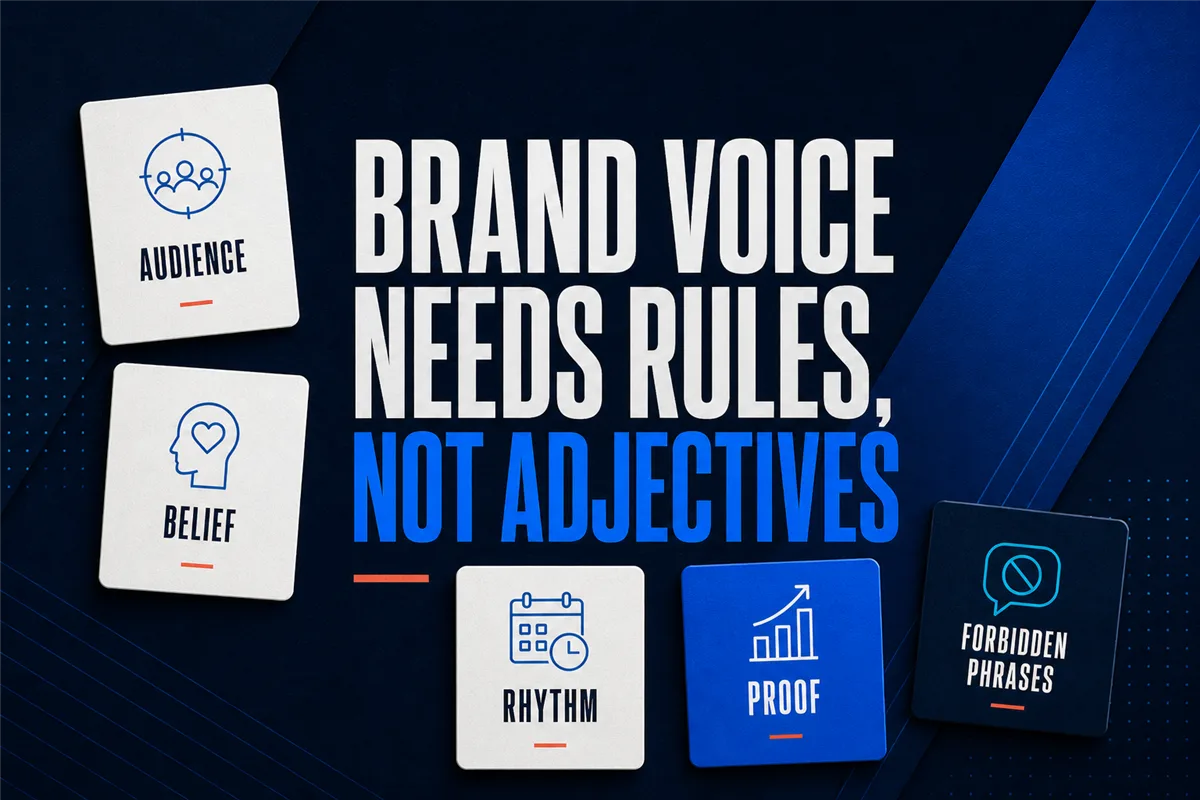
Replace mood words with decisions. Specify the reader, the belief, the sentence rhythm, the evidence standard, and the language boundary. A usable voice guide should help someone choose between two sentences without asking the founder which one feels right.
Part one: a precise reader
Name the person behind the audience segment. A founder of a twenty-person service business has different pressures from a procurement leader in an enterprise. Their time, risk, vocabulary, and proof requirements shape the voice.
Write down what the reader already knows, what they are tired of hearing, and which decision they must make next. This keeps the copy from explaining basics to experts or hiding a practical answer behind brand theatre.
Part two: a belief with consequences
A voice becomes recognisable when it carries a consistent belief. The belief should affect advice. If a brand believes strategy must precede automation, its content should repeatedly connect tools to owners, evidence, and outcomes rather than celebrate features alone.
Test the belief by asking what the brand would disagree with. If no reasonable person could disagree, the statement is probably a value such as quality or integrity, not a useful point of view.
Part three: rhythm people can hear
Rhythm covers sentence length, paragraph shape, directness, and the amount of explanation. It is more concrete than saying the voice is energetic. Provide a short sample that shows how a hook, explanation, example, and question should move.
For SwaDeep's founder voice, short observations can open the argument, but the body should use complete explanatory paragraphs. The aim is direct and commercially literate, not a stack of slogans.
Part four: evidence before claims
Decide which statements need a primary source, which can be framed as an opinion, and which require internal proof. This protects credibility when AI assists with drafting because the system cannot turn an attractive statistic into a public claim without verification.
Create an approval rule for dates, percentages, product capabilities, legal claims, and client outcomes. Link the evidence in the working file even when the final copy only needs one clean source note.
Part five: a stop-using list
A blacklist is often more useful than another adjective. Remove phrases that flatten the voice, such as game-changing, in today's fast-paced world, unlock potential, and seamless solution. Add claims the brand will not make without proof.
Review real copy after a month. Keep rules that reduce editing, revise rules people misinterpret, and add examples from approved work. The guide becomes an operating asset when it learns from use instead of remaining a PDF nobody opens.
Putting brand voice checklist into practice
A growing company asks a founder, marketer, designer, and AI tool to write about the same service. Begin by writing the actual choice in plain language. The goal is not to document every possibility. It is to make the owner, consequence, constraint, and next action visible to the people who must execute or review the work.
Use the official source as evidence for the specific signal it reports: Canva's 2026 trend forecast frames imperfect, personal, and culturally grounded expression as a response to generic polish, including India-specific interest in heritage and local visual language. Keep that attribution close to the claim. Do not turn a product announcement, platform recommendation, or company study into a universal prediction about every organisation.
Make the operating rule explicit: define audience, belief, rhythm, evidence, and language boundaries. Give the rule an exception path. Someone should know when routine execution must stop, which context must be added, and who has authority to accept a tradeoff.
Test the rule on a small but real piece of work. Use representative content and include one difficult case, because an easy example will not reveal whether the guidance survives pressure. Ask the next person in the workflow to explain the intent back in their own words.
Review editing time, recognition, and consistency across writers. Record the baseline, the review effort, and the reason an output was accepted or rejected. A fast first draft is not an efficiency gain if senior people spend more time repairing it or if the work weakens customer trust.
After several uses, keep the decisions that reduce confusion and remove the documentation nobody consults. Add an example only when it resolves a recurring ambiguity. The finished system should make good judgment easier, not make a small team feel as if it is operating a large compliance department.
This approach also gives AI better context. Instead of asking for generic best practice, provide the audience, source pack, rule, boundary, and acceptance test. Require the output to flag missing evidence. Human review can then focus on the decision that matters rather than cosmetic correction.
Write one short decision record after the review. Capture what the team chose, why it chose it, which evidence mattered, and what would trigger another review. This small record prevents the next project from reopening settled questions while leaving a clear path for change when the context or evidence genuinely moves.
Finally, explain the rule to someone who did not help create it. If that person cannot apply it to a realistic case, the guidance still depends on hidden context. Improve the example, boundary, or ownership until the decision can travel without requiring the founder to repeat the original conversation.
Related Vedam Vision reading
Frequently Asked Questions
What does brand voice checklist mean in practice?
It means define audience, belief, rhythm, evidence, and language boundaries. The exact workflow should match the consequence, ambiguity, and reversibility of the decision.
How should a small team start?
Choose one real workflow, document the baseline, define one owner and one acceptance test, then run a contained pilot before scaling.
Where should AI be used?
Use AI for research support, drafting, comparison, transformation, and repeatable execution where sources and outputs can be reviewed. Keep human ownership for positioning, exceptions, and consequential decisions.
Which metrics matter most?
Track editing time, recognition, and consistency across writers. Include review effort and rework so a fast draft is not mistaken for an efficient workflow.
How do we keep the result credible?
Separate facts, assumptions, and opinions. Link factual claims to reliable sources, label uncertainty, and name the person who approves the final outcome.
The practical conclusion
A usable brand voice tells people how to make choices in a sentence, not merely how the finished copy should feel. The next move is small and concrete: choose one decision, expose the evidence and tradeoff, give it an owner, and review whether the outcome improved. Keep the source attached to current factual claims and keep opinion clearly framed as opinion. Revisit the rule after real use, because the purpose is not to defend the first framework. It is to help the team make a sound choice with less confusion and more accountable speed. That is how a useful idea becomes a repeatable business capability.