Quick Answer
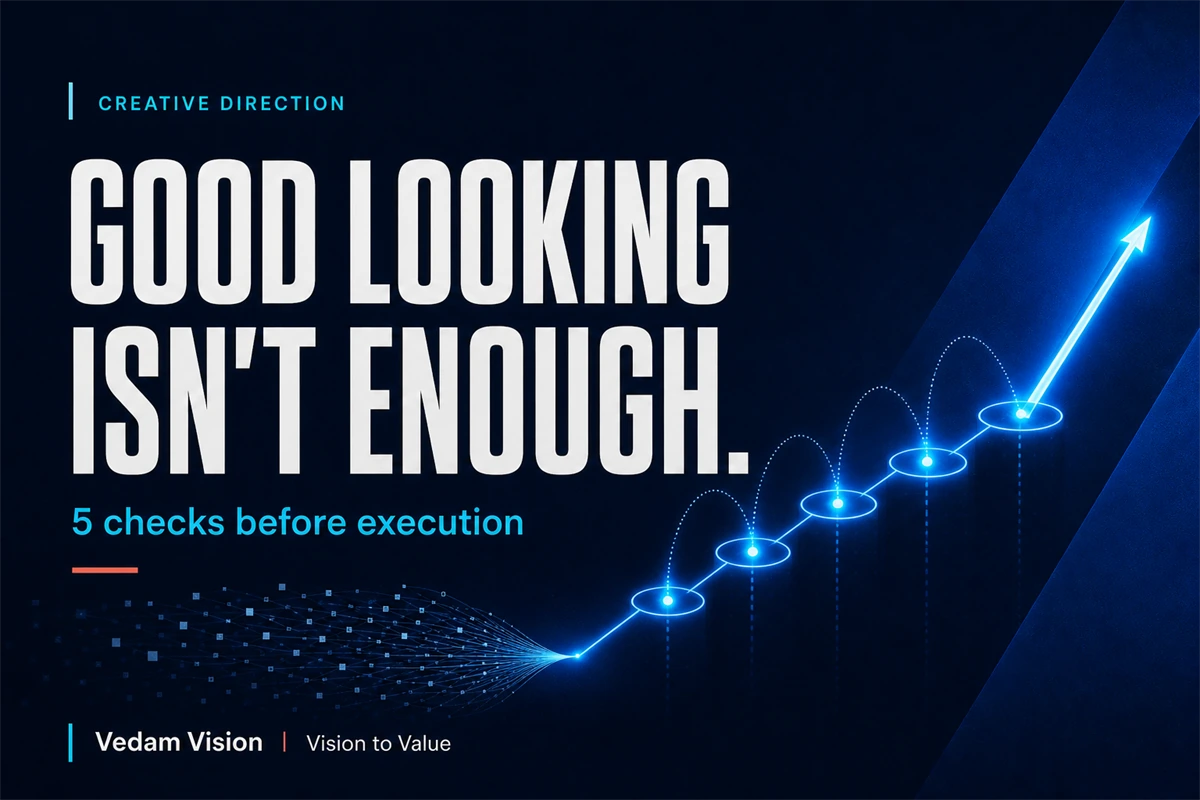
A useful creative idea should pass five tests before a team invests in a moodboard or production: relevance, clarity, distinctiveness, feasibility, and business value. The test does not replace creative judgment. It gives that judgment a practical brief, exposes weak assumptions early, and helps a founder explain why one idea deserves execution while another should stop.
Creative teams often begin where the work becomes visible. They collect references, choose colours, explore typography, and build a moodboard. That activity feels productive because it creates something a client or founder can see.
The harder work happens one step earlier. What is the idea? Why should this audience care? What should change after they see it? Why is this direction right for this business now?
If those questions remain unresolved, a polished moodboard can hide a weak idea. The team may spend days improving execution while the strategic problem remains untouched.
The better sequence is simple: test the idea first, then give the strongest idea enough creative room.
Why Creative Ideas Need a Business Test
Canva's 2026 design perspective describes a shift from polish toward presence. Its argument is that when professional-looking output becomes easier to produce, polish alone loses some power to differentiate. Work that feels intentional, human, and connected to a point of view becomes more valuable.
That does not mean teams should make careless work. It means the value moves upstream. The question is no longer only whether the execution looks professional. The question is whether the idea contains evidence of thought.
For a founder, this distinction matters. A campaign can be beautifully produced and still fail to explain the offer. A landing page can feel premium and still sound like every competitor. A social post can attract attention without building any useful association with the brand.
Creative quality and business quality are not opposing forces. A clear business test protects both. It prevents the creative team from polishing an idea that cannot carry the brief, and it prevents the business team from reducing creativity to decoration.
This is related to the broader principle that design is a business decision, not a matter of taste. The goal is not to ask whether the founder personally likes the idea. The goal is to ask whether the idea can perform the job assigned to it.
Test 1: Is the Idea Relevant to a Real Audience Problem?
Relevance comes before originality.
An idea can be clever, culturally current, and visually surprising while missing the customer's real concern. The audience does not reward effort it cannot connect to its situation.
Write the audience problem in one plain sentence. Avoid category language. A customer rarely wakes up wanting a “digital transformation solution” or an “integrated brand ecosystem.” They want fewer missed enquiries, more confidence in a purchase, a faster way to complete a task, or a clearer reason to trust one provider.
Then ask three questions:
- Does the idea begin from that problem or from a trend the team wants to use?
- Will the intended audience recognise itself without a long explanation?
- Is the idea appropriate for the customer's current stage of awareness?
An early-stage prospect may need the problem named clearly. A returning customer may be ready for a deeper product story. A recruitment campaign needs a different emotional and informational job from a sales campaign.
Relevance is not a promise that everyone will like the work. It is evidence that the right people can see why it concerns them.
Test 2: Can the Idea Be Understood Quickly and Repeated Accurately?
Clarity is not the same as simplicity. A complex idea can be clear when its central point is easy to state and the supporting detail appears in the right order.
Use the one-sentence test. Ask someone outside the project to read the idea, then explain it back. If the explanation changes the meaning, the team has a clarity problem.
Look for common causes:
- The idea contains two competing promises.
- The metaphor is more memorable than the product.
- The audience must understand internal terminology.
- The visual device needs a paragraph of explanation.
- The call to action asks for a different decision from the message.
Clarity also helps execution. A photographer, copywriter, designer, and media buyer can make aligned decisions when the central idea is stable. When the idea is vague, each person fills the gap with personal interpretation. The result becomes polished but fragmented.
Clear does not mean predictable. It means the surprise strengthens the point rather than replacing it.
Test 3: Is the Idea Distinctive for This Brand?
Distinctiveness is not novelty for its own sake. It is the ability to recognise whose idea it is and why that brand has permission to say it.
Remove the logo and brand name. Could the direction belong to five competitors? If yes, the team may be using category codes without adding a point of view.
Check four sources of distinctiveness:
- Position: the specific choice the business makes about whom it serves and what it values.
- Evidence: a product truth, operating method, customer insight, or capability competitors cannot easily copy.
- Voice: a consistent way of explaining the problem and treating the audience.
- Visual system: recognisable type, colour, composition, motion, imagery, and texture used consistently.
A logo cannot do all this work alone. The article on four layers that build trust beyond a logo explains why recognition grows through a wider system of behaviour, message, and design.
The strongest creative idea often reveals something true about the business. It does not simply place the business inside a popular visual style.
Test 4: Can the Team Execute It Well With Available Resources?
Some ideas are good but wrong for the current conditions.
Feasibility includes budget, time, skills, approvals, channel requirements, legal constraints, asset availability, and the number of formats required. A concept built around a cinematic film may fail if the launch needs forty regional performance assets in ten days.
Do not use feasibility to kill ambition too early. Use it to identify the essential creative mechanism. Ask what must remain for the idea to work and what can change without weakening it.
For example:
- A live event may become a documented customer demonstration.
- A complex animation may become a sequence of strong still frames.
- A celebrity-led idea may become a credible expert-led explanation.
- A large campaign world may begin as one repeatable content series.
Define the minimum excellent version, not the cheapest possible version. If the minimum version cannot carry the idea, either change the conditions or choose another idea.
Feasibility should also include maintenance. A brand device that takes six hours to recreate for every post will not become a consistent system in a small team.
Test 5: What Business Value Should the Work Create?
Every creative brief needs a named decision or behaviour.
The value may be direct, such as generating qualified enquiries. It may be intermediate, such as helping a buyer understand a complex offer, improving recall, increasing confidence, or giving a sales team a clearer story.
Choose a small number of indicators that match the job:
- Message comprehension
- Qualified response
- Completion or click-through
- Sales conversation quality
- Branded search or direct traffic
- Saves and shares from the intended professional audience
- Reuse across teams and channels
Do not demand immediate revenue from every piece of communication. Also do not accept “awareness” as an excuse for having no success criteria.
The article on attention versus demand offers a useful distinction. Attention can be an early signal. Demand requires stronger evidence. Decide which signal the creative work is meant to influence.
Score the Idea Without Pretending Creativity Is Mathematics
Use a simple red, amber, green review for each test.
Green means the answer is clear and supported. Amber means the idea may work but carries an unresolved assumption. Red means the idea cannot currently perform the job.
Do not average the colours into a meaningless score. A red on relevance or clarity is usually a stop. A red on feasibility may invite a redesign. An amber on distinctiveness may require stronger brand evidence.
Record the reason beside each colour. The explanation matters more than the rating.
The review can take twenty minutes when the brief is clear. It is cheaper than discovering the same problem after production.
Use the Test in a Creative Review
Run the review with a small group. Include the decision owner, creative lead, and someone close to the customer or channel. Too many reviewers encourage taste-based feedback and diluted responsibility.
Present the idea before the visual references. Give the group the audience, problem, desired change, and central thought. Then review the five tests.
End with one of four decisions:
- Proceed to creative development.
- Revise one named assumption.
- Hold until a missing condition is resolved.
- Stop the idea.
Name the owner and deadline for any revision. Otherwise, “needs work” becomes an open loop.
Once an idea passes, protect it from random changes. Feedback should improve relevance, clarity, distinctiveness, feasibility, or value. If a comment does none of those things, it may be personal preference rather than useful direction.
Final Takeaway
A moodboard is a tool for exploring how an idea should feel. It is not a substitute for deciding what the idea must do.
Test relevance, clarity, distinctiveness, feasibility, and business value first. Then let the creative team make the strongest version of an idea that has earned execution.
Good-looking work is useful. Thoughtful work that changes the right decision is more valuable.
Frequently Asked Questions
Should every creative idea use the same five-part test?
The five questions are a practical default. Teams can add channel, legal, cultural, or technical checks when the project requires them, but relevance and clarity should remain central.
Does a business test reduce creative freedom?
It should do the opposite. A clear problem, audience, and outcome give the team a stronger boundary within which to explore surprising and distinctive execution.
When should the moodboard be created?
Create it after the central idea has passed the initial business test. The moodboard can then explore visual tone, references, materials, composition, and production choices that strengthen the idea.
Who should approve a creative idea?
Use one named decision owner informed by the creative lead and people close to the customer, channel, and relevant constraints. Avoid approval by an undefined committee.
How do we know whether a creative idea worked?
Measure the signal connected to its job, such as comprehension, qualified response, recall, conversion, sales conversation quality, or consistent reuse. Review the result against the original brief.