Quick answer
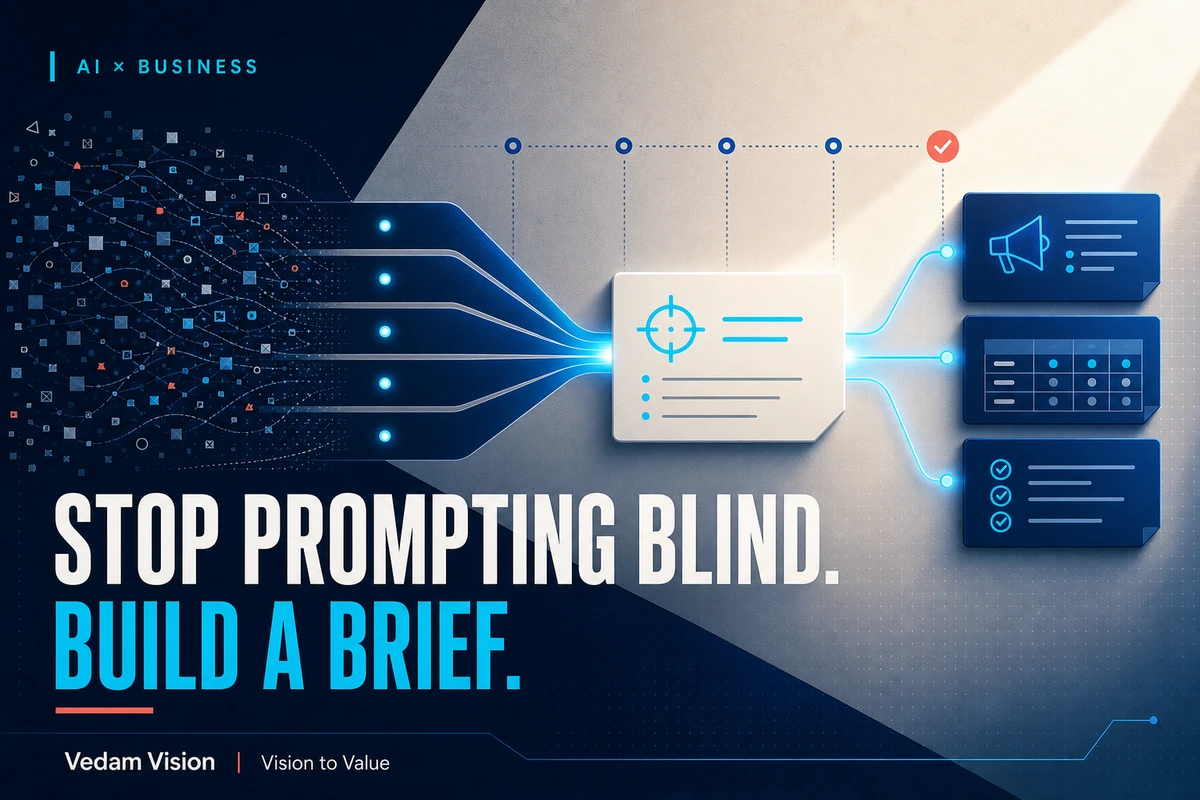
A useful AI prompt is not a clever sentence. It is a compact working brief. Give the model a business outcome, the relevant context, clear instructions, boundaries, the required output format, and a way to check the result. Then test that prompt against several real inputs before your team reuses it. This turns prompting from individual trial and error into a repeatable business process.
Many teams begin using AI with a blank chat box and a vague instruction.
"Write a sales email."
"Make this post better."
"Summarise this report."
The model responds quickly, but the result often feels generic. A team member edits it, tries another prompt, and moves on. The next person starts again from zero. After a month, the business has plenty of AI activity but very little reusable knowledge.
The problem is rarely a missing secret phrase. It is a missing brief.
Google Cloud's official prompting strategies guide describes prompt engineering as a test-driven, iterative process. It also separates prompt content from prompt structure. The model needs relevant information, and it needs that information arranged clearly enough to follow.
That is a useful standard for an Indian SME. You do not need a prompt engineer for every department. You need a small framework that captures how your business wants a task done.
What an AI prompt should do for a business
A prompt should reduce avoidable ambiguity.
Think about how you brief a capable new employee. You would not simply say, "Prepare the proposal." You would explain who the prospect is, what they asked for, which services are relevant, what must not be promised, how pricing should appear, and when the document is due.
AI needs a similar level of direction. The difference is that a model cannot notice missing context and walk to the next desk for clarification unless you deliberately design that behaviour.
A good prompt therefore performs three jobs:
- It states the result the business needs.
- It supplies the information required to produce that result.
- It defines how a person will judge whether the output is usable.
The third job is easy to miss. A prompt that asks for "high quality" gives no test. A prompt that asks for a 120-word WhatsApp follow-up, written for a warm lead, with one next step and no unverified claim is much easier to review.
The BRIEF prompt framework
Use BRIEF as a practical AI prompt framework for recurring business work.
B: Business outcome
Start with what the task should achieve, not only what the model should create.
Weak: "Write a product description."
Stronger: "Help a first-time buyer understand whether this water purifier fits a family of four and encourage a WhatsApp enquiry without using fear-based claims."
The stronger version gives the output a commercial purpose. It also gives the reviewer a clearer basis for judgment.
Keep the outcome realistic. A prompt can help produce a useful lead follow-up. It cannot guarantee that the lead will convert. It can help compare vendor proposals. It cannot take responsibility for the final purchase decision.
R: Relevant context
Provide the facts the model should use.
For a marketing task, context might include the audience, offer, price range, delivery area, brand voice, proof points, and the channel where the copy will appear. For operations, it might include a policy, process notes, order data, exception rules, and the role of the person receiving the output.
Do not make the model guess facts that already exist inside the business.
The official Google Cloud guide lists contextual information and examples among the components that can guide a model. That does not mean every prompt needs a long background section. It means the context should match the decision.
If you are summarising a customer call, include the transcript and your lead-stage definitions. If you are drafting an invoice reminder, include the payment status and approved tone. If you are creating a social post, include the underlying idea and any claim that requires a source.
I: Instructions and boundaries
Describe the work and the limits.
Useful instructions may cover sequence, tone, exclusions, risk controls, and escalation. For example:
- separate confirmed facts from assumptions
- do not invent a price, statistic, testimonial, or delivery date
- flag missing information before drafting
- use plain Indian English
- keep the message suitable for WhatsApp
- do not include customer personal data in the final output
Boundaries matter because fluent writing can look correct even when it is unsupported. A model may complete a pattern with something plausible. Your prompt should make uncertainty visible instead of allowing it to disappear inside confident language.
E: Expected output
Specify the shape of the answer.
Do you need a table, a customer message, a JSON record, a checklist, or three options with different tradeoffs? State the length, fields, order, and labels.
For example:
"Return a table with four columns: issue, evidence from the transcript, recommended action, and owner. Use one row per issue. If an owner is not named, write 'unassigned'."
This is more useful than asking the model to "analyse the meeting." Structure makes the result easier to check, copy, compare, and place into an existing workflow.
F: Feedback check
End with a quality check the model and reviewer can apply.
Ask the model to confirm that every claim comes from the supplied material, list any missing inputs, or score the output against a short rubric. Then require a human to approve the result when it affects customers, money, contracts, safety, hiring, or reputation.
The feedback check should not be ceremonial. If the model reports that a shipping date is missing, the workflow must pause or route that item to a person.
NIST's official Generative AI Profile treats testing, evaluation, verification, and validation as part of responsible generative AI use. A five-line prompt does not replace those controls. The BRIEF framework simply helps a small business make its instructions and review points more explicit.
A reusable prompt template
Copy this structure into your team's approved prompt library:
BUSINESS OUTCOME
Help us [specific business result] for [audience or process].
RELEVANT CONTEXT
Use only the information below:
[facts, source material, customer stage, policies, examples]
INSTRUCTIONS AND BOUNDARIES
[steps to follow]
[what must not be invented or disclosed]
[when to stop and ask for clarification]
EXPECTED OUTPUT
Return [format, fields, length, language, tone].
FEEDBACK CHECK
Before finishing, verify [accuracy, completeness, constraints]. List missing information separately.
This template is intentionally plain. A team should be able to read it without learning AI vocabulary.
Example: turning a vague sales task into a reliable workflow
Imagine a B2B equipment supplier in Indore receives enquiry notes from its sales team. The owner wants AI to draft follow-up emails.
The vague prompt is: "Write a follow-up email for this lead."
A BRIEF version could say:
Help the sales executive move a qualified enquiry toward a 20-minute product call. Use only the lead notes and approved product sheet below. Identify the buyer's stated problem, connect it to one relevant product capability, and propose two call slots. Do not invent a discount, installation timeline, stock position, certification, or customer result. Use professional Indian English and keep the email under 160 words. Return a subject line, email body, and a separate list of missing facts. Confirm that every product claim appears in the approved sheet.
That prompt does not remove the salesperson. It removes repetitive drafting while keeping the important commercial judgment visible.
If the lead asks for a custom warranty, the model should flag the request. The salesperson or owner decides what the company can offer.
Three business tasks that benefit from the framework
Customer conversation summaries
Ask AI to separate customer statements, commitments made by your team, open questions, risks, and next actions. Provide a fixed vocabulary for lead stage and urgency. Require a link or quotation back to the source transcript for any material commitment.
This is especially useful when conversations move between calls, email, and WhatsApp. It reduces the chance that a casual message becomes an undocumented promise.
Content repurposing
Start with one approved source, such as a founder interview or product guide. Define the audience and channel for each output. Require the model to retain the central claim, avoid new facts, and mark any section that needs a source.
Vedam Vision's guide to AI content creation for Indian brands explains why tools still need human judgment around brand, accuracy, and context. A reusable prompt makes that judgment easier to operationalise.
Operations exception reports
Use a prompt to classify issues in a daily spreadsheet or ticket export. Define each category, include two or three examples, and state which conditions require escalation. The output should support a person making the call, not hide the exception behind a summary.
For a broader adoption plan, the decision-first approach in AI strategy for business is a useful companion. Choose the workflow and owner before selecting the model or automation platform.
How to test a prompt before the whole team uses it
One successful output proves very little. Test the prompt with a small set of varied cases.
| Test case | What it reveals | Pass condition |
|---|---|---|
| Normal case | Whether the basic instructions work | Output is accurate and usable with light editing |
| Missing information | Whether the model invents details | Missing facts are clearly flagged |
| Unusual request | Whether boundaries hold | Exception is routed for human review |
| Long or messy input | Whether structure survives | Required fields remain complete |
| Sensitive input | Whether the workflow is appropriate | Data is removed, masked, or kept out of the tool |
Keep the test inputs free of unnecessary personal or confidential information. Check the provider's data controls and your own obligations before placing business data into any AI system.
Record the prompt version, model used, test date, examples, failures, and the name of the person who approved it. Models and business rules can change, so review important prompts periodically.
Build a prompt library, not a prompt graveyard
A shared folder full of unnamed text files will not improve consistency.
For each approved prompt, store:
- prompt name and business purpose
- owner
- approved inputs
- restricted data
- expected output
- example of a good result
- known failure cases
- review date
- version history
Keep only prompts linked to a real workflow. Delete experiments that nobody owns. If a prompt produces an output that still needs a person to rebuild it every time, revise the prompt or stop using it.
Teams that want to connect prompts to customer, content, or reporting workflows can explore Vedam Vision's AI solutions and automation services. The sensible starting point is one repetitive task with clear inputs and an accountable reviewer.
Common prompt mistakes
The first mistake is adding adjectives instead of information. "Make it compelling, premium, engaging, and viral" does not tell the model what a serious buyer needs to know.
The second is asking one prompt to do an entire department's job. Research, legal review, pricing, creative direction, and final approval should not be collapsed into a single generation step.
The third is supplying an example that contradicts the written instruction. Models respond strongly to patterns in examples. Review samples with the same care as the prompt itself.
The fourth is changing the prompt after every imperfect output without identifying the failure. Was context missing? Was the format unclear? Did the model lack access to the relevant source? Fix the cause rather than making the prompt longer by habit.
The fifth is treating a good draft as an approved business action. A polished email is still a draft until the responsible person confirms the facts and offer.
Start with one useful prompt this week
Choose a task your team performs at least several times a week. Pick one that has stable inputs, a visible output, and a person who can judge quality.
Write the prompt using BRIEF. Test it on five real but safely prepared cases. Note where it fails. Revise it once. Then let two team members use the same version and compare their results.
The value is not the prompt alone. The value is the business knowledge you make explicit: what good looks like, what must be true, what must never be invented, and who makes the final call.
That is how an AI prompt framework becomes a small operating system for better work, not another collection of clever phrases.
Frequently asked questions
What is an AI prompt framework?
An AI prompt framework is a repeatable structure for giving a model the outcome, context, instructions, constraints, output format, and quality checks needed for a task. It helps a team brief similar work consistently.
Does a longer prompt always produce a better answer?
No. A prompt should contain relevant information and clear structure. Extra detail that does not affect the task can create noise. Test the shortest prompt that reliably produces an accurate, usable result.
Can one prompt work across every AI model?
The core business brief can often be reused, but models differ in capabilities, interfaces, context handling, and tool access. Test and version the prompt for the model and workflow your team actually uses.
What business data should we avoid putting into AI prompts?
Avoid unnecessary personal, confidential, regulated, or commercially sensitive data. Check the provider's controls, your contracts, customer expectations, and applicable law. Mask or remove data when the task does not need it.
Who should approve an AI prompt in a small business?
The process owner should approve the business instructions and output standard. A suitable risk, legal, security, or leadership reviewer should also be involved when the prompt affects sensitive data, contracts, people, payments, or regulated decisions.