Quick answer
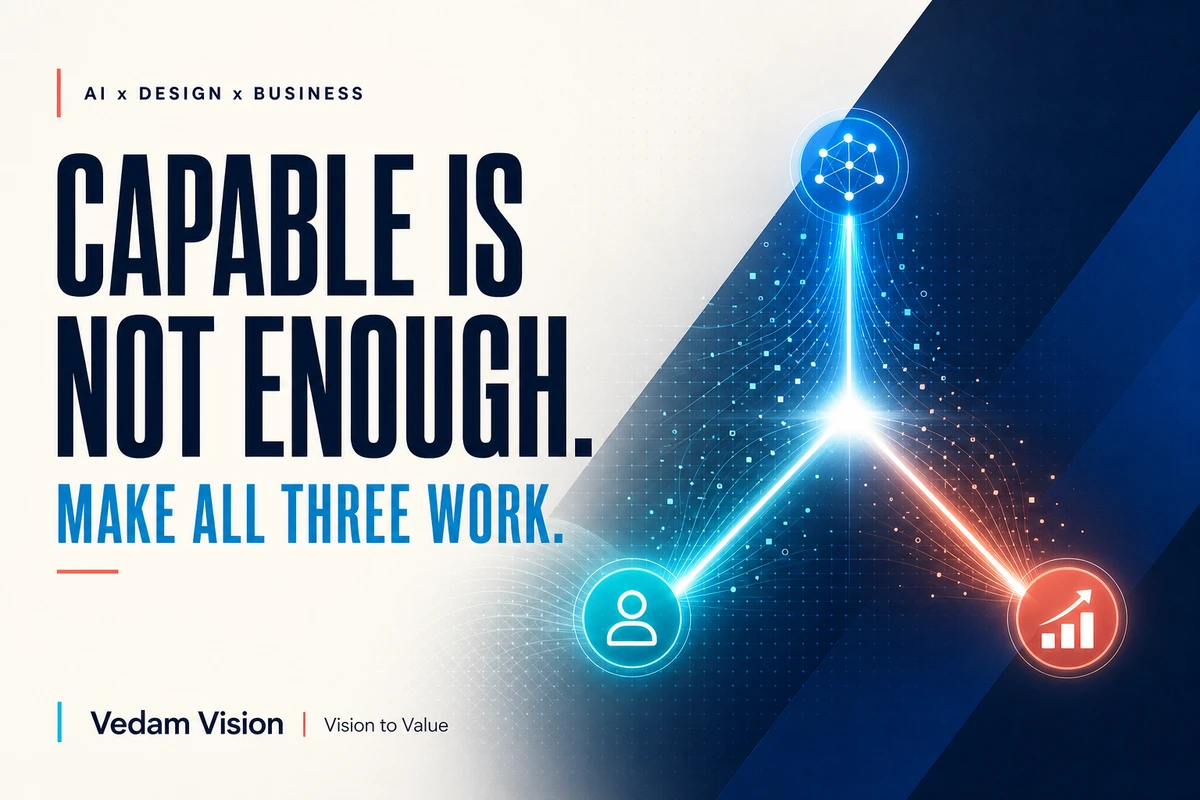
An AI design business strategy works only when three conditions meet. The system must be capable of performing the task reliably enough. The experience must be usable, understandable, and controllable by real people. The result must create commercial value after cost, risk, and operating effort. A strong score in one corner cannot rescue failure in the other two.
Many AI projects begin with a capability demonstration.
The model can summarise a document, generate an image, classify a ticket, or answer a question. The demo feels impressive, so the team moves quickly toward launch.
Then reality arrives.
Employees do not know when to trust the answer. Customers cannot correct a mistake. The integration adds more steps than it removes. The cost grows with usage. The output does not affect a business metric anyone owns.
The technology worked. The product did not.
A practical AI initiative needs three connected views: capability, usability, and commercial value. Treat them as a triangle. Weakness in any corner changes the decision.
Corner one: capability
Capability asks whether the system can perform the defined task under real conditions.
Do not ask only, "Can the model do this?" Ask:
- Which inputs does it handle well?
- Which languages, formats, and edge cases cause failure?
- How consistent is the output?
- What evidence supports the answer?
- How quickly does it respond?
- What happens when information is missing?
- Can it use the required business data and tools safely?
- How will changes in the model or source data be detected?
A demonstration uses a clean example. A business process receives incomplete forms, mixed Hindi and English, scanned PDFs, abbreviations, old records, unusual customer requests, and contradictory instructions.
Test with the mess, not only the ideal.
NIST's AI Risk Management Framework includes validity and reliability among the characteristics of trustworthy AI and places testing and monitoring across the lifecycle. Capability is not a one-time model score. It is performance inside a specific workflow.
Corner two: usability
Usability asks whether people can understand, control, and recover from the system.
An accurate model can still create a poor experience.
Imagine an AI quotation assistant that produces a technically correct draft but hides assumptions inside a long paragraph. The sales executive must inspect every line to find missing taxes, delivery conditions, and payment terms. The system saves typing but increases review effort.
Useful AI design makes important states visible:
- what the system used
- what it is unsure about
- what action it proposes
- what the person can edit
- what requires approval
- what will happen next
- how to cancel or correct an action
Google's People + AI Research guide on user needs and defining success recommends finding the intersection of user needs and AI strengths. It also distinguishes automation from augmentation. Tasks with high error costs or disagreement about the correct answer may need more human control.
That is a better starting question than "Where can we add AI?"
Corner three: commercial value
Commercial value asks whether the initiative improves the economics or strategic position of the business.
Possible value includes:
- faster cycle time
- higher capacity without equal headcount growth
- fewer avoidable errors
- better lead response
- improved conversion
- lower service cost
- stronger customer retention
- new paid capability
- better management decisions
Benefits must be compared with the full cost:
- model and software charges
- integration and maintenance
- data preparation
- review time
- training
- security and compliance
- exception handling
- vendor switching risk
- failure and correction
If an AI system saves ten minutes but creates fifteen minutes of checking, the demo has not created leverage.
Vedam Vision's article AI Is Not the Strategy. Better Decisions Are. places tool choice after the business decision. That sequence protects the commercial corner of the triangle.
How the triangle changes the project decision
| Capability | Usability | Commercial value | Decision |
|---|---|---|---|
| Strong | Strong | Strong | Pilot with clear controls and metrics |
| Strong | Weak | Strong | Redesign the workflow before scale |
| Weak | Strong | Strong | Narrow the task or improve evidence and tools |
| Strong | Strong | Weak | Stop, re-scope, or treat as learning rather than rollout |
| Unclear | Unclear | Unclear | Run discovery, not procurement |
The table prevents capability excitement from becoming automatic approval.
Example: an AI lead qualification assistant
Consider a growing education company receiving enquiries from forms and WhatsApp.
Capability test
Can the system extract course interest, city, learner stage, budget signal, timeline, and missing information from real messages? Can it handle Hindi-English mixtures and voice-note transcripts? Does it flag uncertainty rather than inventing a field?
Usability test
Can a counsellor see the source message beside the extracted fields? Can they correct the record quickly? Is the reason for priority visible? Can they override the recommendation? Does the system separate a suggestion from a final decision?
Commercial test
Does it reduce first-response time or manual sorting? Do qualified prospects receive faster contact? Does conversion improve enough to justify software, integration, and review costs? Does the team actually use it?
Only when all three tests are credible should the business scale.
Design the review before the interface
Teams often design the happy path first. AI products need the review and failure path early.
Define:
- which outputs are automatically accepted
- which require sampling
- which always require approval
- what confidence or evidence is shown
- what conditions stop the workflow
- who owns an exception
- how a correction improves future operation
- which actions can be reversed
The user experience should make responsibility clear. A bright button should not hide a high-risk action. A friendly chat interface should not suggest authority the system does not have.
For customer-facing products, test the language used to explain AI involvement. People need enough information to make an informed choice without reading a technical paper.
Capability should be specific to the task
"Our model is 95 percent accurate" is not enough.
Accurate at what, on which data, under which conditions, and with what consequence when wrong?
Break the task into observable parts. A document assistant might need to identify the correct file, extract fields, cite the source, compare rules, and format a recommendation. One weak stage can undermine the whole workflow.
Use a test set drawn from the business. Include normal cases, incomplete cases, rare cases, adversarial or confusing inputs, and examples where the right answer is to ask for help.
Track performance by segment. A tool may work well for typed English invoices and poorly for photographed regional-language receipts. The average can hide the failure that matters.
Usability includes organisational fit
An interface may be easy to click and still fail inside the company.
Ask who owns the data, who handles exceptions, which team approves changes, and how the output enters existing systems. If employees must copy information across three tools, adoption will suffer.
Training should cover judgment, not only button location. Users need examples of good use, bad use, uncertainty, escalation, and prohibited data.
Vedam Vision's website design and development service focuses on the experience around technology. The same discipline applies to internal AI tools: a working feature is not finished until people can use it reliably.
Commercial value needs a stop rule
Every pilot should have a decision date.
Before starting, record:
- baseline
- target
- measurement source
- total expected cost
- risk limit
- owner
- review date
- scale, revise, or stop criteria
Do not keep a weak pilot alive because the team has already invested time. Learning that a task is not suitable for AI can be a useful result.
Calculate value at the workflow level. A cheaper model may require more human correction. A more capable model may be unnecessary for simple classification. A custom integration may create value only at sufficient volume.
Run a triangle review
Bring product, design, operations, finance, and the actual user into one 60-minute review.
Score each corner from one to five, but require evidence beside the score.
For capability, attach test results and known failure cases.
For usability, attach observed task completion, correction effort, user feedback, and failure recovery.
For commercial value, attach baseline, cost, expected benefit, and decision rule.
Then discuss the weakest corner first. The weakest corner usually determines the next action.
If capability is weak, narrow the task or add better context and tools. If usability is weak, redesign controls and workflow. If commercial value is weak, stop or choose a more valuable problem.
A balanced AI design business strategy
AI capability creates possibility. Design turns possibility into a usable experience. Business discipline decides whether the experience is worth operating.
None of the three is optional.
The strongest teams do not ask whether AI is impressive. They ask whether it works for this task, whether people can use and control it, and whether the economics justify the risk and effort.
That triangle creates fewer flashy demos and more durable business value.
Frequently asked questions
What is the AI, design, and business triangle?
It is a decision model that evaluates an AI initiative across technical capability, human usability, and commercial value. All three need sufficient evidence before scale.
Can a highly capable AI tool still fail?
Yes. It can fail if users cannot understand or control it, if it does not fit the workflow, or if operating cost and risk exceed the value created.
How should a small business test AI capability?
Use representative real-world cases, including missing information, unusual inputs, and examples where the system should stop or request human help.
What counts as usability for an AI system?
Usability includes clarity, control, correction, appropriate expectations, recovery from failure, and fit with roles, systems, and operating processes.
How do we know if an AI pilot has commercial value?
Compare measured benefits with total costs and risks against a baseline. Define a review date and clear criteria to scale, revise, or stop.