Quick answer
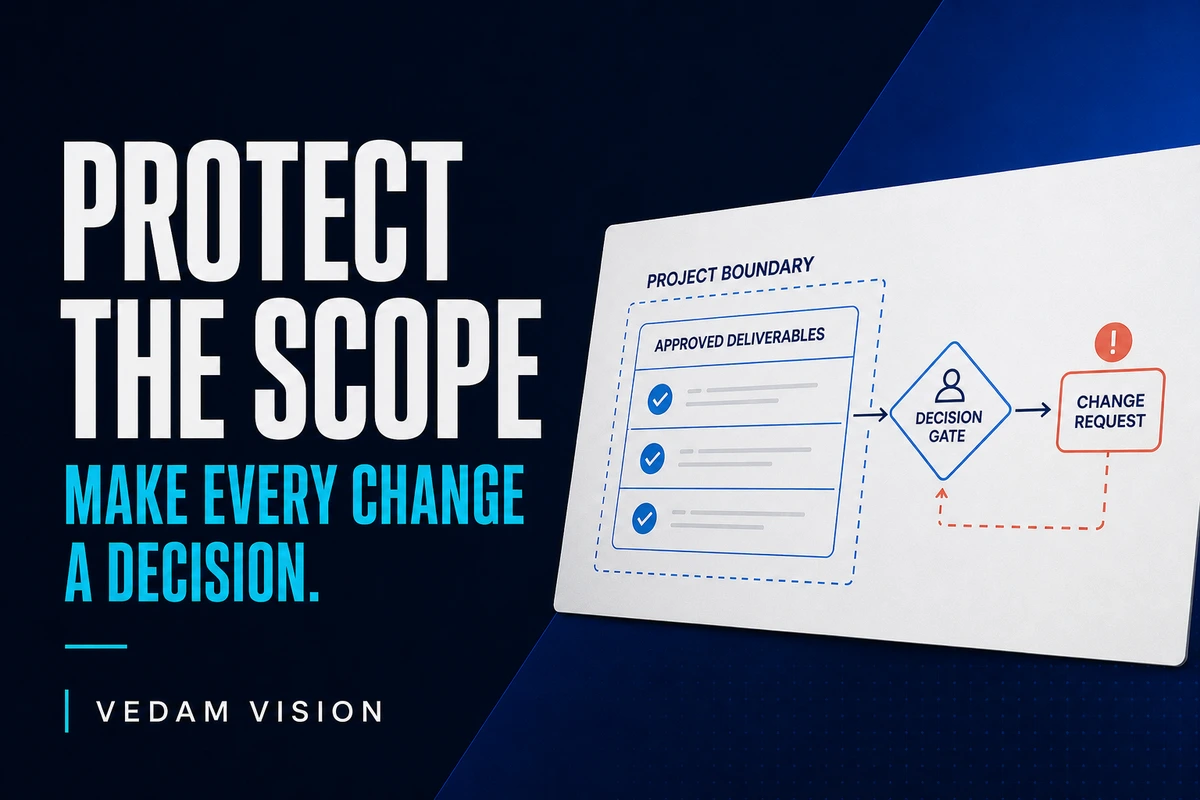
A scope protection checklist defines the project outcome, deliverables, exclusions, decision owner, review rounds, approval method, change-request process, and the effect of changes on time, cost, and quality. It does not prevent collaboration. It makes new requests visible so the client and creative team can choose them deliberately instead of allowing silent scope creep.
Scope creep rarely begins with a dramatic demand.
It begins with a small request that appears harmless: one extra format, another decision-maker, a new audience, a rewritten page, or a late idea that changes the original direction. The request may be reasonable. The problem is that nobody checks what it changes.
Creative businesses protect relationships when they make scope decisions clear early.
Scope is a shared agreement
Scope is not a defensive document created to control the client. It is the team's shared description of what success includes.
Project management standards treat scope, requirements, schedules, and funding as items that need defined change management. The Project Management Institute's published PMBOK material describes effective change management as an expected project outcome when requirements evolve.
Creative work needs flexibility, but flexibility works better when the baseline is visible. A change can then be accepted, deferred, exchanged, or declined with a reason.
Why creative projects are vulnerable
Design and content projects contain interpretation. A phrase like “complete brand identity” can mean a logo and essential rules to one person, and a full library of templates, packaging, signage, motion, photography direction, and campaign assets to another.
Several conditions increase the risk:
- the outcome is described only in broad language
- deliverables are not counted
- exclusions are missing
- several people can approve
- feedback arrives through different channels
- revisions have no limit
- a new audience appears after work begins
- the timeline assumes immediate client response
- the team is afraid to discuss commercial impact
The answer is not a longer contract filled with legal language. It is a clearer operating agreement.
The scope protection checklist
1. State one business outcome
Begin with the reason for the project.
“Redesign the website” describes an activity. “Help qualified buyers understand the service and request a consultation” describes an outcome.
The outcome guides tradeoffs. When a new idea appears, the team can ask whether it supports the agreed purpose or creates a different project.
Avoid promises that the creative work cannot guarantee. A website can improve clarity and conversion conditions. It cannot guarantee a revenue figure without many other factors.
2. Name every deliverable
List deliverables in countable terms.
For a website project, include pages, templates, content responsibility, forms, integrations, responsive states, migration, analytics, training, and launch support. For a brand project, include logo versions, colour system, typography, guidelines, templates, file formats, and applications.
“Social media assets” is vague. “Six LinkedIn portrait templates and six matching caption structures” is clearer.
3. Write the exclusions
Exclusions prevent assumptions.
If photography, copywriting, paid media, printing, custom development, translation, domain fees, or ongoing management is not included, say so. A respectful exclusion can also point to a later phase or separate estimate.
Exclusions should not be hidden. Review them in the kickoff so both sides understand the boundary.
4. Name the decision owner
One person should consolidate and approve feedback for the client. One person should own delivery decisions for the creative team.
Stakeholders can contribute. The decision owner resolves conflicts before feedback reaches production.
Without this role, a project can move backward after each review because different stakeholders optimise for different goals.
5. Define the review rhythm
Specify when the client reviews strategy, direction, draft, and final work.
Ask for consolidated feedback by a date and through one channel. Explain what each review is intended to decide. A direction review is not a final proofing review. A final proofing round is not the moment to choose a different strategy.
This reduces surprise and gives stakeholders the right moment to influence the work.
6. Define what a revision means
A revision improves an approved direction within the agreed brief. A new direction changes the brief, audience, outcome, or major concept.
State how many revision rounds are included and what happens when they are used. Count rounds, not individual comments. Encourage the client to collect input before submitting each round.
The goal is not to charge for every small correction. It is to prevent an unlimited cycle where approval has no meaning.
7. Create a change-request path
When a new request appears, record:
- what is being requested
- why it is needed
- which deliverable changes
- effect on timeline
- effect on fee or resources
- quality or dependency risk
- approval to proceed
The process can be a short email or project form. It does not need bureaucracy. It needs a decision.
8. Protect the timeline from waiting
Creative schedules often depend on client content, access, approval, legal review, or technical information.
State those dependencies and what happens when they arrive late. A two-day review delay may move the final date because the team has other scheduled work.
This is not punishment. It is capacity planning.
9. Define approval
Write how approval is given and what it closes.
For example, approval of the sitemap closes the page structure unless a change request is accepted. Approval of the visual direction allows production to begin. Final approval confirms content and design are ready for launch subject to technical checks.
Clear approval points make progress real.
10. Agree on handover and support
State which files, accounts, documentation, training, and support are included after delivery. Define the support window and distinguish a defect from a new request.
A clean handover protects the client's ability to use the work and the studio's ability to close the project responsibly.
A useful response to a new request
When a client asks for something outside the current plan, avoid an immediate yes or a frustrated no.
Try this structure:
“We can add this. Let us confirm whether it replaces an existing deliverable or extends the scope, then I will show the effect on timing and cost.”
This keeps the conversation commercial and collaborative. The client sees that the idea is possible and that capacity has consequences.
Scope exchanges can preserve budget
Not every change needs a higher fee.
Sometimes the client can exchange one deliverable for another of similar effort. A second landing page may replace a brochure. Three social templates may replace a presentation section.
Document the exchange so the baseline stays current. Do not rely on memory after several weeks of decisions.
Protect quality, not only margin
Scope protection is often discussed as a profitability issue. It is also a quality issue.
When the same deadline absorbs extra work, the team may reduce research, exploration, testing, proofing, or documentation. The client receives more items but weaker attention.
A clear change decision lets both sides protect what matters. They can extend time, add budget, reduce another deliverable, or accept a narrower quality level knowingly.
This connects to Vedam Vision's article on why design is a business decision. A creative choice should be connected to purpose, evidence, and constraint. Scope is where those constraints become operational.
A one-page scope summary
Before work begins, create a one-page summary with:
- business outcome
- target audience
- deliverables and counts
- exclusions
- milestones
- client inputs
- decision owner
- review rounds
- approval method
- change process
- fees and payment triggers
- handover and support
Link the summary to the detailed proposal or contract. Review it during kickoff and keep it visible in the project workspace.
Warning signs during delivery
Pause for a scope conversation when:
- feedback introduces a new audience
- an approved direction is reopened
- a new stakeholder becomes an approver
- content volume grows materially
- formats or channels are added
- technical assumptions change
- client inputs remain unavailable
- the project needs work from another specialist
- repeated revisions reveal that the brief is unresolved
Do not wait until the team is exhausted. Early clarity is kinder than a late invoice or a missed date.
A weekly scope review
For projects longer than two weeks, review five questions:
- What was approved this week?
- What changed from the baseline?
- Which client inputs are pending?
- What threatens the next milestone?
- Does any request need a formal decision?
Send a short written record. It gives both sides the same understanding and reduces disputes based on memory.
Boundaries support better collaboration
Creative work benefits from discovery and change. The purpose of scope protection is not to remove either one.
It separates exploration from uncontrolled expansion. It gives ideas a clear path and gives the client honest information before choosing them.
A strong boundary is not “we do not do changes.” It is “we make changes deliberately.”
That approach protects the relationship, the commercial agreement, the timeline, and the quality of the work.
Frequently asked questions
What is scope creep in a creative project?
Scope creep is the gradual addition or change of work without an agreed adjustment to deliverables, time, cost, resources, or quality expectations.
How many revision rounds should a project include?
The right number depends on the work, but each round should have a defined purpose, consolidated feedback, and a clear decision owner. Two or three structured rounds are common.
Is every client change chargeable?
No. Small corrections within the approved brief may be included. A change that adds deliverables, reopens direction, or changes the audience or outcome should trigger a scope decision.
How can a freelancer say no to extra work professionally?
Explain the current agreement, describe the effect of the request, and offer options such as an added fee, extended timeline, scope exchange, or later phase.
What should a change request contain?
It should record the request, reason, affected deliverables, time and fee impact, dependencies, risks, and approval to proceed.